
By Peggy Sue Wood | @pswediting
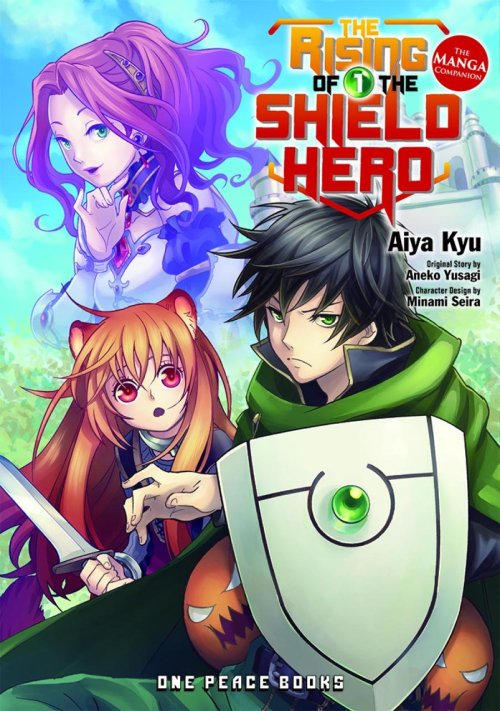
Top of the controversial titles to like this season in anime, according to most everyone I know’s list, is The Rising of the Shield Hero. Why? Well, as you may have heard, it starts off with a false rape allegation against the protagonist and that is enough to have it burned from most watch lists as a potentially good anime or manga in the Western (and probably everywhere else) anime-watching community. However, I think that focusing on this aspect without consideration for the rest of the plot and characters is faulty reasoning. There are a lot of animes with messed up things that happen–including murders (One Piece has a ton, and that gets played off as a generally happy-go-lucky series), torture (Overlord anyone?), and instances where rape is heavily hinted as an outcome for a character in addition to assault that actually took place (SAO tentacle scene ringing any bells? How about Goblin Slayer?). Considering that I’ve met at least one woman in my adult life that is like the redheaded princess that made a false claim in the anime and manga (and presumably the light novel series this is based on), it doesn’t seem impossible. It’s rare, for sure, but not impossible.
Taking a moment here, in American culture, of which I am speaking as a female, American citizen, false rape allegations are a major issue because women already struggle to be believed when they are, indeed, victims. So many women do not go forward about sexual assault as it is and media that portrays women in such a poor light only reinforces the horrific mindset of “she probably wanted it” or “she probably just regretted it” or “she’s making it up” that seems to be so prevalent in our culture.
When false allegations are made, it only hurts real victims more. Media often likes to villainize groups of women as a result, and it makes it harder for victims to come forward out of fear that they will be penalized for speaking the truth–which also happens way too often for anyone to feel comfortable with given the current state of affairs. Looking at this anime, it is hard for some to get behind the portrayal of this in any sort of media since we know how much it hurts victims, but let’s take a moment to look at the anime/manga’s response to this setup. (*Please note, this is not an argument defending rapists or anything of the like. I am an avid supporter of victims of sexual assault and kindly ask that you don’t misconstrue my words. If you would like to question me further, wish to see me amend something stated here, or want to debate what I’ve written regarding this subject, please feel free to message me. I am always open to criticism or revisions.)
What happens initially after the rape allegation is that everyone, save for the blacksmith and, after a short while, the people that later get to know Iwatani Naofumi (our protagonist), believes the victim. That is super rare for our culture, and even after the allegations come to light as being false, not everyone believes that he’s really innocent. Instead, the people continue to see him as a villain/rapist, which is even more surprising given the fact that he should have a lot of support given his prior actions and title. His title alone should have given him status enough to stand against her–I mean, he is (1) one of the four summoned heroes; (2) a hero that protects the masses more than the other three; (3) one that advances the most by investing in/learning about the culture he’s in and not just making assumptions because it reminds him of a book/game/whatever; (4) one that tries his best despite his severe disadvantages that continue throughout the series thus far (I’m only at Chapter 50 in the manga); and (5) thinks critically about the state of affairs for the people beyond surface-level (like cleaning up the corpse of a slain monster that one of the other heroes killed and left on the ground where it began poisoning the land and people living there).
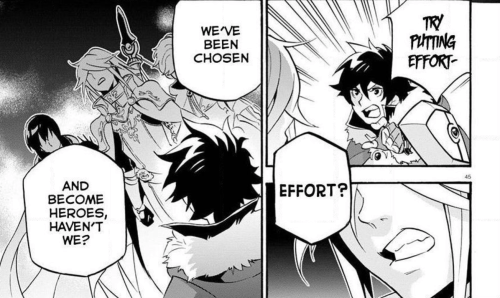
SIDE NOTE: Even after being proven innocent, the Spear Hero still says stuff like this (Chapter 44):
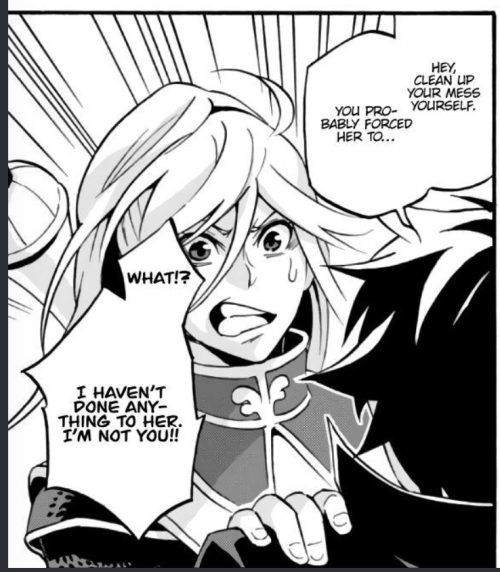

By the way, Chapter 44 is where the ranged/arrow hero’s bad side really comes out. Just saying…
Naofumi lives through the allegation because he is a hero, so his status is helpful in that regard, but look at him compared to the others. Because of their hero status, the other heroes get away with a lot of ridiculous behavior, including their lack of foresight and not having to listen to the queen of the country they are summoned in (it’s a matriarchy system by the way, so they’re literally insulting the head of the country they live in and get away with it whenever they disregard her, which is something NO ONE else would be able to do).
Yes, the manga makes it clear that the reason he is disregarded so easily is that he is the “Shield Hero” and not many respect the shield in this particular country, BUT he is still one of the four major heroes that they NEED to survive the waves. Angering him is not in their best interests, yet they still disregard/disown/hate him because of this allegation (even after it is proved to be false). The situation, the society, is vastly different from our own and that’s something I appreciate from the series.
Don’t get me wrong, I’m not a fan of the rape allegation opening, but I can still appreciate that the author used it as more than just a means to put the hero in a bad starting position. As with most starting plot points, the allegation puts the protagonist into place for his hero’s journey adventure while also setting up one of our antagonists for the series’ first arc. In addition to this though, it adds a world-building element to the story. Here, women are still considered relatively weak and damsel-like when it comes to fighting, but they have way more political and social power than men by comparison. The other three heroes don’t really experience this initially because they act like this is all a game and exist/live maintaining their patriarchal perspective hence the way the Spear Hero–a man who acts like he is all about women (protecting them, showing off to them, etc.)–doesn’t consider how the female characters that want to be with Naofumi feel. This idea can be applied to the others too since all the heroes disregard the queen regularly after the king is removed from power (before they were very amicable toward the king).
If you are counting, that means the scene does three things. First, it acts as the starting plot point–setting up the protagonist’s starting point and an antagonist. Second, it shows that this is a matriarchal society in which women have more political and social power than men. Third, it shows/helps the protagonist understand that society and culture are truly different here. The rules are different here. By extension, that means it is not a game–in games, justice always prevails (typically), but that is not the case here.

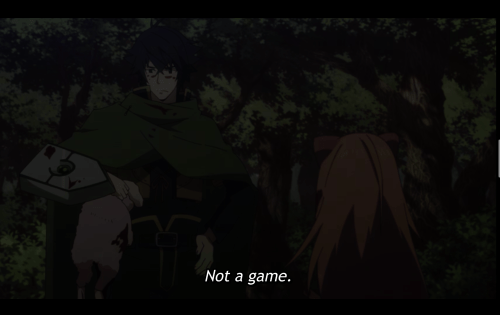
The anime is pretty different too in the setup since they reveal more differences right off the bat than letting you know over time (like how the country is a matriarchy) and having Myne, the accusor, put a lot more work into tricking Naofumi than in the manga (in the manga, she never fights for him or tells him much about the world, instead letting him figure it all out after they’ve parted). In the manga, Naofumi is an active character, while Myne is bidding her time for that evening to trick him. Naofumi buys her the gear to protect her without instigation, while in the anime she tricks him into buying gear for himself that she uses to win over the Spear Hero. Moreover, Naofumi has to convince the court to let him live because of his role in the manga, whereas in the anime they say they’re letting him live because of his role, essentially taking away an important essence of Naofumi’s character (the essence that he is capable, more so than the other’s even realize, of adapting to the world around him).
Another change that I’m not a particular fan of is the other heroes saying that he should at least do his job of saving the world after all this–one that they wouldn’t do at all without proper payment according to their anime selves. There are a lot more differences too like in the payment scene where Naofumi is given more than the others. The changes all make Naofumi out to be more passive and victim-like in the anime, maybe because those adapting the series knew that the start was really controversial and wanted to make Naofumi as likable as possible before his inevitable, anti-hero-like personality comes into play, and while I don’t like it I can kind of understand it from a storytelling perspective since there is no guarantee that this series will get a second season (and as things stand now, it probably won’t) so let’s move on.
Emphasizing the difference between him and the other heroes, in a way that is more obvious than the other three continuing to think this is a game over the course of the series, is how much knowledge Naofumi gains about the world, which brings us to another controversial subject in this anime/manga: slavery. (*Please note, I don’t condone slavery either. I’m just analyzing its role in the manga and anime as critically as I can. Also, check out Chapter 16 to see how the three still think it is a game even though they are on the verge of defeat.)
Having distinguished that this is another world with rules different from our own, we find that here (in the summoned world), slavery is real, and Naofumi uses that to his advantage. He doesn’t particularly like the idea, but he’s not in a position to change it or really go against it. The anime doesn’t let us know how against it he is, choosing to stay out of Naofumi’s head for most of the episode, but it’s pretty obvious in the manga, and manga spin-off which features the Spear Hero as the protagonist, that Naofumi is not a supporter of slavery. Still, he’s not in a position to change the rules of the country. NONE of the heroes are, and Naofumi understands that better than most considering that he is thrown from grace in the summoned queendom early on. With not many options, none at the start really, he buys a slave, but despite his harsh words, readers can see that Naofumi isn’t planning to force the slave girl, Raphtalia, into doing something not up to a skill level that he can’t defend her from (at least at the start).
Only after the pivotal scene in which Naofumi allows Raphtalia to make her own choice about continuing to fight does their relationship (him forcing her to fight and keeping her as a slave) change. After she agrees to continue fighting for him, he never really orders her to do anything like that again, and the tone of the story and their relationship hints that she’s free to go whenever she likes, and if she chooses to do so of her own free will. In the manga, when the Spear Hero, most loudly but not alone, confronts Naofumi about slavery, the Spear Hero acts high-and-mighty and is silenced temporarily by the response he gets from Raphtalia before making up his mind that she must be brainwashed. Even after the rape charge is cleared and a bunch of other things happen, none of the heroes can forgive Naofumi for being a slave owner, but that only makes them stand out even more as flawed heroes within the story. (Not just because they don’t listen either.)
See, the beauty of this show is that the hero’s path, no matter which one you take, is one uniquely flawed. The Shield Hero has disadvantages and to overcome them he has to get his hands dirty with sins he never would have considered otherwise. The other heroes choose to be lone wolves, playboys, and snobbish–they suffer from hubris, and so while they are not aware of their sins, their path is as stained with blood as Naofumi’s is, if not more sp. The only difference is that Naofumi is aware of it and tries to use these sins to help others. With Raphtalia, for example, instead of buying a strong slave that he could have gotten in order to level up faster, he chose one he could help get stronger and healthier because if he had to have a slave, he felt that he might as well chose one he could help.
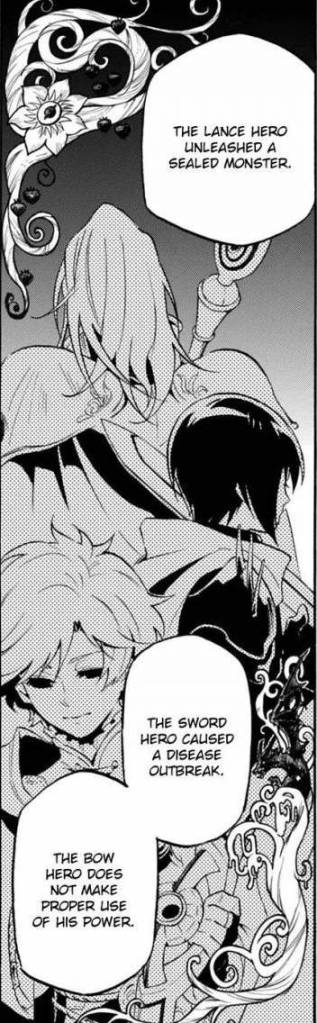
The others, however, justify their sins in ridiculous ways, the most egregious of which is their sheer lack of concern for the people of the land. They constantly take care of surface-level issues without concern for the deeper problems or nuances that come from such situations. Like killing a monster to upgrade their gear and not caring that the corpse literally poisons the land meaning the people can’t grow food or drink the local water without suffering from contamination. Or invading another person’s hunting territory during the leveling island adventure arc and not caring that it upsets people and prevents them from leveling up in ways that may allow them to protect their homes since heroes can’t be everywhere.
I wouldn’t be surprised if all of the other heroes ultimately suffer horribly by the end, with Naofumi living quite well-off for his efforts–maybe even being able to abolish slavery, though that does not seem to be a priority for him at all right now.
The good end wouldn’t be simply because he’s the protagonist, it would be because he’s worked for it. If you take the spin-off as canon (I don’t know if it is), the Spear Hero certainly suffers betrayal at the end. That aside, I wouldn’t be surprised with the other three heroes suffering has nothing to do with their dislike of Naofumi, after all, Naofumi doesn’t make it easy to be likable to other characters (an anti-hero to the readers, in my opinion). The reason I wouldn’t be surprised if the other three heroes ultimately suffer a bad end is because the other three heroes suffer from hubris while Naofumi does not. If, like me, you’re a fan of ancient Greek and Roman heroes, you know that heroes who have hubris tend to fall on their own swords because of it. Already we see that their arrogance is causing the heroes that were once superior in fighting strength to begin to suffer greatly for their hubris as the waves continue getting harder and harder. The other heroes are falling more and more behind Naofumi in the necessary skills for living, and fighting, in this world.
In the end, it’s hard for me to hate this series when the storytelling elements are so strong. It paints its world as one filled with complicated grey areas, which is true of our own world and circumstances. By doing so, The Rising of the Shield Hero seems to be a transformative element in its genre. Not that other isekai stories aren’t attempting this kind of nuance in their writing, but that the depth of this series stands apart in the current season and I don’t hate it.

So, if you are on the fence about whether or not to watch this series–I hope that this analysis has helped.
Discover more from The Anime View
Subscribe to get the latest posts sent to your email.

One thought on “[Analysis] Controversial Opinion: The Rising of The Shield Hero, I don’t hate it + Why”