
By: Peggy Sue Wood | @pswediting
Welcome, fellow alchemists and (humor) enthusiasts, to a lighthearted exploration of the wild world of chemistry history using Fullmetal Alchemist as the base for our discussion because today we’re diving into the notion that alchemy was basically chemistry before they decided to ditch all the woo-woo shenanigans. Grab your philosopher’s stone and let’s embark on a journey through the transmutation circles of science!
Alchemy was, historically speaking, the OG of woo-woo sciences. Philosopher’s stones, mystical symbols, and the pursuit of the elixir of life were all part of the package deal. In a whimsical revival of the historically disproven science, the creator of Fullmetal Alchemist (FMA) decided to give alchemy a 21st-century makeover that took the almost-mumbo-jumbo that was once used as a method to help heal people (not just make them rich) and turned into war crimes.
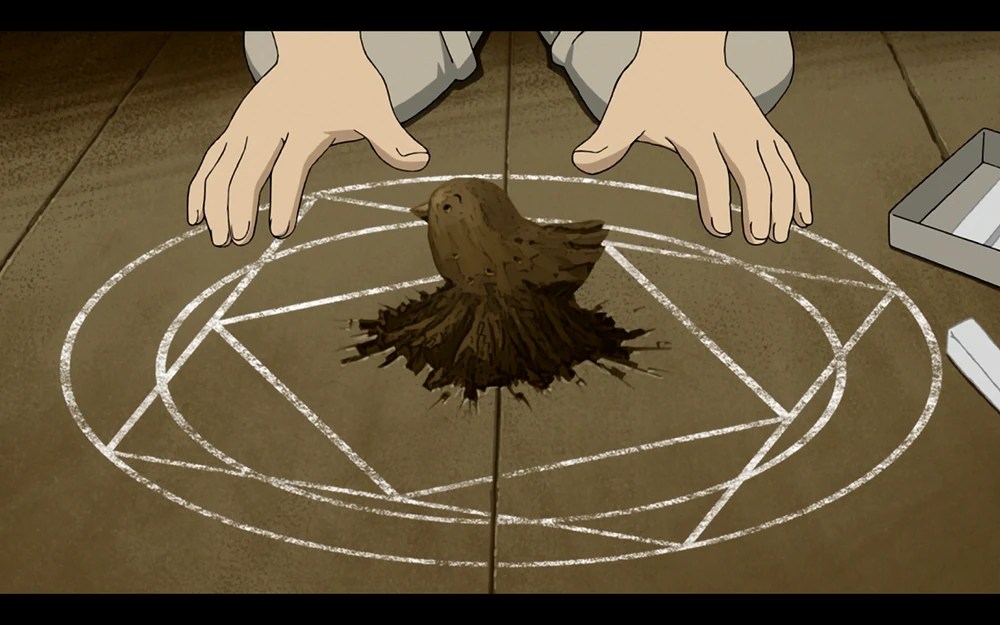
Of course, as the Elric brothers progressed in their alchemical adventures, it becomes increasingly clear that the mystical side of traditional alchemy had been replaced by a more down-to-earth, science-y vibe for the series, which is nice. I mean, sure, there were still flashy transmutation circles and cool glove-snapping fire sequences, but beneath the surface, it all boils down to some actual science regarding chemical reactions (you know, plus the occasional explosion for dramatic effect). However, in all seriousness (not really), alchemy in FMA is about the weaving of periodic tables, and less about magic. Equivalent exchange is the golden rule of alchemy, ensuring that nothing is gained without something of equal value being lost. This principle may sound a lot like the laws of thermodynamics, but hey, alchemists had it first! Forget about balancing chemical equations: the Elric brothers were masters of balancing the cosmic scales while pulling off jaw-dropping feats against a bunch of homunculi.
OKAY, now, sincerely—setting aside the April Fools aspect of this post.
FMA does give some credibility to the ideas behind Alchemy from a historical sense. I mentioned above that it used to be a healing science, and that’s because it was. We didn’t have chemistry the way we have it now, in the same way that we didn’t have medical knowledge and access to technology that we do now. There are a lot of things that we don’t understand about the human body and while we know more now than in the past, that doesn’t mean that some of things we consider “common” knowledge won’t be outright nightmarish ideas to the future of humanity, in the same way that lobotomies are now considered stuff of horror films but were actually viewed as a sincere advancement in treatment that was practically the only effective treatment for severe mental conditions until more advancements could be made.
While alchemists in modern interpretations are sometimes given fantastical myths in games and stories, or seen as greedy horrible con artists, there was a time when they were blurring lines with medical doctors. Arguably, what founded chemistry as a science is alchemy.
Much like the World War that inspired FMA’s militaristic storylines, this adjustment of using Alchemy as their base for magic—a magic system routed within workable science concepts—is a fascinating revival of the ideas of what alchemy used to be for parts of the world: a science. While outside of this is ties into a major concept of FMA, which is that neither a complete reliance on religion or a complete reliance on “science” is truth because both are incomplete sets of knowledge and ideas.
With so may religions in the world, many that have overlapping ideas and many that have significantly divergent ideas as well, we don’t know what the exact “truth” is, because we don’t have all the pieces. The same can be said for our sciences. I mean, we just learned in the last five years how general anesthesia works, assuming that the study is correct because it, too, is building off of theories and “proofs” for those theories that we have about the human body.
It’s an interesting look, essentially, at how the creator of FMA, Hiromu Arakawa, has so deeply developed that major theme that it even boils down to the real-world example of Alchemy.
I really think it is a fascinating concept and so, if you have time, I encourage you to take a glance at the history of the topic!
—
Editorial Note: This post was inspired by Krow’s stimulating comment when I compared FMA’s alchemy to bad chemistry: “Alchemy was chemistry before they got rid of all the woo-woo shit.” I felt like this was just the perfect line to inspire a really borderline comedic post for our return. Thanks for reading!
–
If you enjoyed this post, please consider buying us a coffee, leaving a comment, and/or subscribing to us below!
Copyedited by: Krow Smith | @coffeewithkrow and Katherine Cañeba | @kcserinlee
Discover more from The Anime View
Subscribe to get the latest posts sent to your email.

