
By: Peggy Sue Wood | @pswediting
Sekaiichi Hatsukoi (and its related series Junjou Romantica) has always been an interesting series to me because of the snippets of real-world publishing details that come into play.
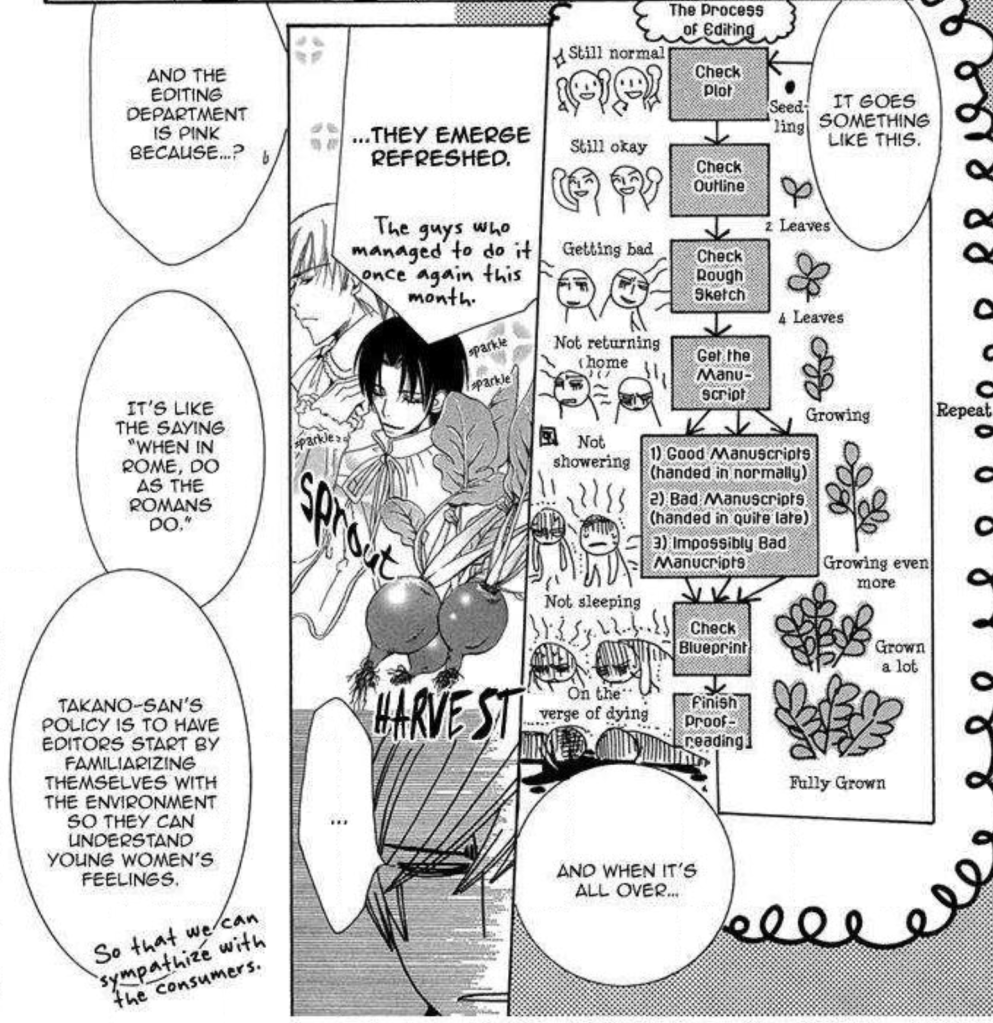
In fact, when I first became interested in entering a publishing career back in freshman year of college, this series was recommended to me by a close friend of mine. I distinctly remember laughing at the breakdown of the editing process above from Chapter 2 (and I even had this printed out and posted by my desk when I interned at DC Comics, earning a slight chuckle then too!).
Sekaiichi Hatsukoi, for those new to the BL series, began serialization in 2006 and continues to update now. It received an anime adaptation in 2011, which adapted the image above into an equally hilarious slide deck-like scene that eventually made its way into becoming one of the funniest AMVs I’ve seen to date: “Editing Gives You Hell! ~ Sekaiichi Hatsukoi AMV” by VidserventCat.
The series follows the romantic relationships of several characters who all happen to work for or with Marukawa Publishing’s shojo manga magazine, publishing under the title Emerald. For those of you unfamiliar, this is a relatively normal thing in publishing, with many publishers having a collection of various titles and imprints.
Fun fact: Marukawa Publishing house is, interestingly enough, based off of Kadokawa Publishing and actually uses Kadokawa’s building as a model:

While much of the series is about the romance aspect, the charm for me remains in how the author consistently works in the intricacies of the publishing industry. They show, for example, how passionate the editors are about the series that they work with, how tight deadlines can create really stressful situations for the whole production line, and overall offer a somewhat realistic portrayal of the everyday struggles faced by those involved in the creation of these beloved stories.
Now, I am comparing this to my experiences with American comic publishing of late 2010s, so some things have very likely changed over the last handful of years, but I think that some of these things are still applicable today. For example, the editorial head attending marketing meetings was super relatable. When I was an intern, and when I became an editorial assistant to a pair of Acquisition editors at Wiley, it was not uncommon to see (or attend) meetings regarding the marketing of the work in question. A lot of times there would be a review of cover art at another meeting, and you could find editors of a series they’d recently been assigned to reviewing archives of past works in the series to build a solid reference for where the story has gone and where it is going.
While I don’t think that every editor maybe has contacts with the local bookstore, there are definitely some who do. For example, there was a bookstore close to where I worked at Wiley that tracked and managed an employee book club. Now, in American comic publishing, editors have a much larger role in creating the story than people may expect. While authors are the producers of the content, you can have multiple authors contributing to different issues in the series and that’s because the editor is usually the spearhead or point person on the story itself, which I do not think is universal. Japan seems to have a more traditional model of the story following the author, and moving publishers with said author when contracts allow.
This aside, I really enjoy getting to see snippets of experiences I have had or can speak to in a series that is largely about romance. It is even more fun with Junjou Romantica now as I’ve shifted back towards education and writing. I get to see similar snippets such the Hiroki Kamijou, a literature professor at Mitsuhashi University, complaining about students and holding a rather strict philosophy on what college should be like for his students (like, being there to study and setting the phones aside).
The love-story aspects are also pretty interesting and depict questioning behaviors early on, which I think settle down a lot as the series has progressed and queer culture continues to gain more acceptance internationally (still a struggle, but improving). For example, I feel a lot more connected now to Hiroki than I did when I first watched the series some 10+ years ago. As much as I think Junjou Egoist‘s (their storyline’s title in the show/manga) Hiroki is too violent with his love interest and too much of a tsundere for his age (29, which is my age as I write this, though I will be 30 by the time this posts), I can’t help but feel a match for how I can be sometimes. I both want to be and am super supportive of my students but sometimes catch myself frustrated by their behavior (I mean, Krow has heard me complain about how obvious it is when they don’t read probably 100x by now this semester alone). Moreover, like Hiroki, I absolutely hate losing and will overwork to exhaustion at things that are overall troublesome when faced with the possibility of a challenge—something I’m working on. There are other traits too that I connect with, and those can be challenging in a relationship, which I think the author shows and gives some grace to as his character, Hiroki, improves. It kind of feels like the author is saying, “Hey, over-achiever who is working a lot of hours and not sure about romance being in the cards for you—there’s hope!”
Anyway, I watched a pretty censored version of both animes (Sekaiichi Hatsukoi and Junjou Romantica) years ago and have rewatched them a few times since, often skipping the episodes that had couples I didn’t like, and my review here boils down to this:
The anime and the manga are a product of the time and culture of which they were first written, so don’t read it or watch it from the perspective of having 20/20 vision on how culture will change. Consider that, for the time this was first coming out, this was a rather progressive series and may arguably still be one. I mean, for example, in the Junjou Romantica manga, where we see the way Misaki Takahashi’s brother finds out about the relationship with Usami. It is such a big event and the aftermath was so much calmer than expected: that really speaks to the growth of the relationships and culture differences the work has seen since the early 2000s. So, if you are not against some lightly censored BL/yaoi anime, I think that this is a good series to watch even if I don’t enjoy all of the couples or even like some of their relationships. In addition to that, you’ll maybe get to see a small peek into the world of publishing and find a newfound appreciation for the art and dedication that go into making the manga we cherish. Beyond that, I think that following the characters on their journey through love and professional growth can be a key point of interest too. Oh, before I forget—the manga is not censored the way the anime was. Be warned! Also, beware the yaoi hands. It’s pretty bad in the manga and anime but, like, really bad in the manga early on. The proportions get better as time goes on but are still pretty bad overall….
With that said, Happy Pride Month!
–
If you enjoyed this post, please consider buying us a coffee, leaving a comment, and/or subscribing to us below!
Copyedited by: Krow Smith | @coffeewithkrow and Katherine Cañeba | @kcserinlee
Discover more from The Anime View
Subscribe to get the latest posts sent to your email.
