
By: Peggy Sue Wood | @pswediting
“Nothing in this world is a coincidence. Everything is Hitsuzen.” ― CLAMP, xxxHolic, Vol. 1 (Hitsuzen meaning inevitability, fate, or destiny as being the driving force of the universe.)
Editorial Note: I am forewarning you now. If you have not seen the movie yet or only vaguely remember it, this post will probably not make sense. Please watch the movie beforehand. You may also want to watch a summary of A Midsummer Night’s Dream.
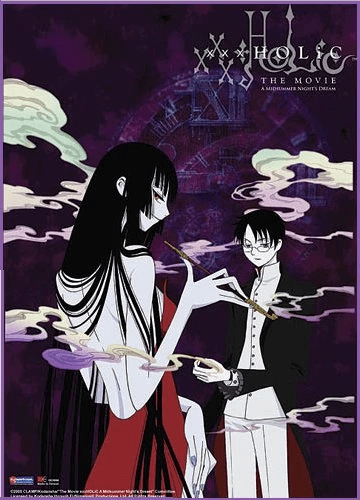
Last summer, I was rewatching the xxxHolic (animated) movie and since then kept coming back to the name. Even in my first watch through, I couldn’t quite let go of it, because it is pretty well-known that the xxxHolic movie shares its name with a well known Shakespeare play, both of them being A Midsummer Night’s Dream.
What gets me about this is that there are no coincidences in xxxHolic, which is established as early as the first episode of the series and the first chapter of the manga. Everything in the series is intentional, and that means that use of the Shakespeare’s title sharing in name of the movie for xxxHolic must have some commonality.
Yet, searching online has turned up with nothing for me to latch onto beyond the name’s similarity. So, after thinking about it for close to a year, I’ve come to realize that, actually, there are three big things in the Shakespeare play (hereafter referred to as “play”) that I think we can connect to the xxxHolic movie (hereafter referred to as “movie”).
First is Dreams and, in a way, the Moon. Everything in the play is explained as being a dream or set of dreams. It frames the work, including the title, and lends to the audience foreshadowing that the play will be either a dream or will talk about dreams. For the movie, I thought that this name was sort of lending to the idea that nothing here is canon to the manga or anime—it will not be mentioned again and is therefore a “dream.”
However, I started to think otherwise after rewatching once again. Particularly as a result of the detailing of the mansion’s labyrinth, which forms a series of scenes that look like they come from other stories or from history with many scenes featuring Watanuki wandering into corridors and rooms that are truly imaginative and fantastical. Interestingly, as things start to get more creepy we transition and see Watanuki outside the house and yet inside the labyrinth.
When things start to get recognizably twisted, we have two moonsights. One moon sighting is right after the dinner scene, when Watanuki walks outside after he sort of wakes up from suffering a nightmare, and goes looking for Domeki who has gone missing.
In the play, there are also two important visuals of the moon, the first notable one is that the moon is up when all the couples of the play enter the magic of the forest.
It is still up or up again in Act 2, when Hermia wakes in the woods, alone, and looks for her love interest, Lysander. She had a nightmare and wants Lysander, who has been temporarily bewitched. When the moon is gone, the dreaming is over, and the play ends with day breaking; so, too, does this movie.
So, we have Watanuki seeing the moon first when he’s entered the “magic” of the house. We see it again when Watanuki wakes and finds the person he entered the labyrinth with (Domeki) to be missing as part of our first connection between the play and movie through imagery. However, we also see this connection through the theme of dreams where the ideas of appearance and reality conflict. What appears to be is not the truth, and if we look at things like the art—what appears is, for example, people enjoying the house, but the reality is the people are suffering and trapped by it (Side note, this reminds me of Doctor Who‘s Family of Blood punishment).
In the play, a dream is not real, even though it seems to be real at the time we experience it. Characters frequently fall asleep and wake having dreamed, having had magic worked upon them so that they are in a dreamlike state; or thinking that they have dreamed. We see this too in our movie, as in their sleep the victims of the house have had magic worked upon them, and woken to something being not right—but are they really awake?
In the play, the answer is “no” because all of the play is a dream transitioning between scenes. So too might this movie be a dream—a transitional state—hence the distortions and why nothing is as it seems.
The next connecting factor is the idea of order and disorder. The play opens in order. It is set in Athens and a daughter, Hermia, wants to marry Lysander but her father wishes her to marry Demetrius. This is a state of order. If she wishes to go against her father the law will have her wed, sent to a nunnery, or sent to death (still set in the realm of order). As the various characters enter the woods, we enter a state of disorder with relationships breaking down and fragmented stories coming together.
However, this is comedy play, and relationships are happily rebuilt in the free atmosphere of the wood before the characters return to society.
So too, once again, do we see this in the movie—not the marriages or couples, but the story opens in a state of order for the series. The characters are on Summer Break and Watanuki is suffering at his summer job. He must do what he dislikes by order of Yūko, enter the mystery house, experience dreams and disorder, and upon exit return to the order of that they left. The movie, like the xxxHolic show, is still a comedy and so (despite the thrills and frightening factors of some of the story) this movie is one that ends with relationships mended to their origin.
To make mended what has been broken, however, in the play, Oberon and Titania (the fae king and queen) must reconciled so that all else can be put right. Our villain, the Collector, is an Oberon-like character—he both sets the magic in motion and corrects the magic/returns to the world (makes it right) at the end (after Puck’s characters, Yūko being a sort-of stand-in, messes it up and is sent to free those entrapped by it). Our instigator, the girl that hires Yūko, is a stand-in for Titania, and helps with the restoration of natural order when having the reunion with our Oberon characters, thereby allowing the victims of the collector go free and returning the movie/play to a state of happiness at the end that could not be complete without their faes’ reconciliation.
What finally brings the story fully into view within the Shakespeare story is Puck’s speech from Act 5, Scene 1, which (to me) solidifies how the xxxHolic movie narrative fits the themes of Shakespeare’s A Midsummer Night’s Dream without ever becoming a one-to-one retelling of the tale. As Puck states:
“If we shadows have offended, / Think but this, and all is mended, / That you have but slumber’d here / While these visions did appear. / And this weak and idle theme, / No more yielding but a dream, / Gentles, do not reprehend: / if you pardon, we will mend: / And, as I am an honest Puck, / If we have unearned luck / Now to ‘scape the serpent’s tongue, / We will make amends [before] long; / Else the Puck a liar call; / So, good night unto you all. / Give me your hands, if we be friends, / And Robin* shall restore amends. (*Robin, by the way, being a native British spirit who personified the medieval character of the ‘Puck’).” (Shakespeare, A Midsummer Night’s Dream, Act 5, Scene 1)
Essentially, where xxxHolic and Shakespeare overlap in this movie is in the themes and partial imagery. We see it in with the use of Dreams/the Moon, the appearance vs. reality, and with the differing states of order and disorder. They are not a one-for-one with each other, as the movie is not a retelling of the play. However, they are not disconnected either, and share more than just a name!
So, what do you all think? Do you see more than the connections drawn here, or do you disagree entirely? Let me know!
–
If you enjoyed this post, please consider buying us a coffee, leaving a comment, and/or subscribing to us below!
Copyedited by: Katherine Cañeba | @kcserinlee
Discover more from The Anime View
Subscribe to get the latest posts sent to your email.


One thought on “[Analysis] xxxHolic & Shakespeare: A Midsummer Night’s Dream (Spoilers)”