

By: Peggy Sue Wood | @pswediting
A while ago I analyzed the concept of a mage defined within the work The Return of the 8th Class Mage. In that post, I briefly talked about the differences between a Mage and a Knight, and I’ve been thinking about it ever since while also continuing to read a lot of manga, manhwa, manhua, and comics within the trend of using a medieval/historical European setting/story inspiration. A lot of these works are romances, but also some that feature the idea of magic, knights, nobility, and other philosophical/societal debates.
One of my latest pick-up reads is Sigrid by Siya (art by GLEE), which follows a female knight after she gets a second chance to live life differently following her death. A pretty standard premise and a relatively interesting story overall. Though if I was going to recommend a story following a female knight I’d more likely suggest Adonis or The Knight and Her Emperor, which are currently on TappyToon. There is also the The Stellar Swordmaster, which I like a lot but which also does not fit the concept fully.
Back to the point, I was reading Sigrid which regularly alludes to the idea of what a Knight is or should be. I’ve discussed this idea before in the post mentioned above, and when reviewing the idea of what makes a King in literary fiction, I find it to be an idea worth briefly revisiting here.
In Sigrid, the argument for what makes a Knight at the start seems to be that a Knight is one that follows orders, but–as our main character learns–there is much more to the idea of “chivalry” and knightly qualities than just obeying. Sometimes you can be selfish, or compassionate to the common people, and this can be a worthy quality in a righteous knight. However, I think that this idea is actually in stark contrast against the Arthurian legend from which the literary qualities of knightly pursuits stem.
Real-world knights prior to the legends (and even after) were not necessarily great. In fact, a lot of them were horrible, particularly to the common people. Knights were of a higher status and born into their roles—often of the noble class or, at least, elevated above the peasantry. They were not like the samurai class, who were often elevated mercenaries, nor were they necessarily hired military help like we view mercenaries today.
These real-world knights were typically bullies with swords, and they used those swords to do what they wanted and get away with it. However, then we had an age of “enlightenment” with ideals and religious doctrine flourishing, along with legends and stories that promoted the idea of noblesse responsibilities. In modern words, the “noblesse oblige” or the idea that if you’re of noble birth, wealthy, or of a higher status, it’s your duty to act righteously and to help others below your station. Continuing with this idea, from my “What makes a King?” post, “In popular works like Game of Thrones, in which we see much of the darker sides to knighthood, oaths, nobility, royalty, and so on–we see the grim reality of Geoffrey of Monmouth’s time. In fact, some argue that Geoffrey’s account and the focus on the knighthood and Arthur’s reign amid war and beyond was a subversive aim to inspire real change among the dark abuses of power that many members of the knightly class, nobility, and above, held.”
The Legend of King Arthur and his Knights of the Round Table led to the rise in fictional idealizations of knights and knighthood. Images that carry to this day, wherein knights are often portrayed as honorable and noble characters much in the same way medieval literature and chivalric romance idealized them to be. By the time we exit the Middle Ages and Renaissance, knights are now considered members of the noble classes that are trained in warfare and combat, and are expected to embody certain virtues, including loyalty, bravery, honor, and so on. There is a chivalric code of conduct for a knight and this code outlines the expected behavior, placing a strong emphasis on upholding these virtues to be a personal honor and one that is foundational to the knight’s reputation, family, and status. Therefore, a knight’s honor was closely tied to his actions and words, and he was expected to uphold his word for a lifetime. If he promises to serve someone, that is who he must serve to maintain his dignity.
By presenting knights in such a heroic embodiment via stories that became legends, it literally changed the foundations of what was once the most terrifying and despicable class in society to one of the most respected classes in modern memory. The stories flattered the enlarged egos of the knightly class but also created a societal expectation that was so strong it became the new norm. The image of the knight as a shining example of honor and chivalry remains—as I write this—a powerful, lasting cultural symbol.
With the abundance of stories coming out that use these ideas of kings and knights and mages now, I find it interesting to see how authors are examining the Knightly qualities of chivalry, honor, and nobility, while redefining what those terms mean against the want for love or money. These new versions of Knights do seem to find their ties in the legacy from the Round, but seem to stem from Sir Lancelot’s archetype—the knight who was the best of them all but fell short in the end due to love—though these knights are without the same negative light that painted the Lancelot’s broken promise.
That said, there are many works that have Knights, but not many that really dive into the idea or concept behind what makes a Knight a knight through their characters. Sigrid could count, but seems to focus more on what makes a good person than a good knight. Instead of that work, Edward’s knight from I Choose the Emperor Ending, or Pollyanna Winter from The Knight and Her Emperor. In their stories, the knight’s oath is brought to question and they must choose between duty and love, but for some reason these characters still fall short for me on defining what it means to be a Knight. I think it is because the story is not really dependent on what it means for the world/kingdom if they break their virtues and vows, which is a distinguishing factor.
If Edward breaks his vows, we see what happens. The noble is cranky but it all works out. If Pollyanna breaks her vows, the Emperor would be ecstatic to welcome her as a bride. Characters like this, whose story is a central plot point and/or focus are important, but they won’t make or break their King which is a central difference to consider because King Arthur was at sincere risk by Lancelot breaking his vows. Lancelot’s actions contributed to the weakening of Arthur’s reign and the overall stability of Camelot by creating rifts between the Knights of the Round. The betrayal and the resulting conflicts among the Knights certainly played a role in the tragic elements of the Arthurian legend, and, in some versions, were a leading contributor to the downfall of the once-great king and his idealized kingdom.
As such, I can’t really use those characters whose stories of betrayal to their vows to fully examine the idea despite being able to identify said characters as good examples of a knight.
Beyond this, it is, to me, an important distinction as I’ve had this conversation a few times with friends who can all identify a knight and claim their virtues, but cannot define them clearly through the focus of the story. How we define a knight is actually more difficult than you may expect because there were several Knights of the Round, and you could probably use any of them as a base for this type of discussion.
To be clear, this idea of “defining” is different from that of identification. Identification is about recognizing or singling out something based on observable features, meaning it’s more about practical recognition. However, definition involves a more abstract and conceptual understanding wherein you are able to provide a detailed and precise explanation of the inherent nature or meaning of that thing.
In essence, any character can probably be labeled a “knight,” but not every character defines or lives up to what a knight truly is as a concept, in the same way that not every “mage” lives up to the archetype of a mage and not every “king” is of king-quality.
In their own ways, each of the Knights of the Round is their own version of the knighthood. Pretty much all of them uphold one major virtue of the era, and all of them fall short with a major vice. This might be the idea of a knight, but this much too broad as it would be a collective of definitions made up of 100s of stories to match the list of anywhere between 25 and 1,000+ Knights of the Round. So, typically, in literature, we would narrow in and likely turn to Sir Lancelot as the main archetype for a Knight since he embodied all the virtues and fell short (or betrayed his King) only because of love.
Sir Lancelot was considered the best of them–intelligent, strong, witty, caring, etc., but he is not the only one. Each Knight of the Round falls short in one area or another, because they are still human and humans have flaws. However, each overcomes the flaw or struggles to death with it as a result of their specific character flaws. Viewing things through Sir Lancelot’s archetype, through his presentation as loyal and trustworthy but choosing to betray a value of knighthood for love (a love for a the master’s wife or a love for the master), is probably the best way to pick and define a true Knight living up to the legacy.
In attempting to explore this idea further, its very difficult to find a representation of a knight that lives up to Sir Lancelot’s archetype as the definition. Arguably the best example I have is Catesby from The Requiem of the Rose King, but that’s relying entirely on the build up and expectations I have for the series’ finale.
In the (manga) story thus far, Catesby is a central figure and we do see by how Richard III – his King – relies on him that if Catesby were to betray him, it would be a breaking point in his foundation. Catesby is his most loyal follower, one who has been given multiple opportunities to leave and yet never does. We see his “oath” in Chapter 50, when we get to briefly see the story from his perspective as he chooses his loyalty to King Richard III over his assigned service to Lord Hastings:


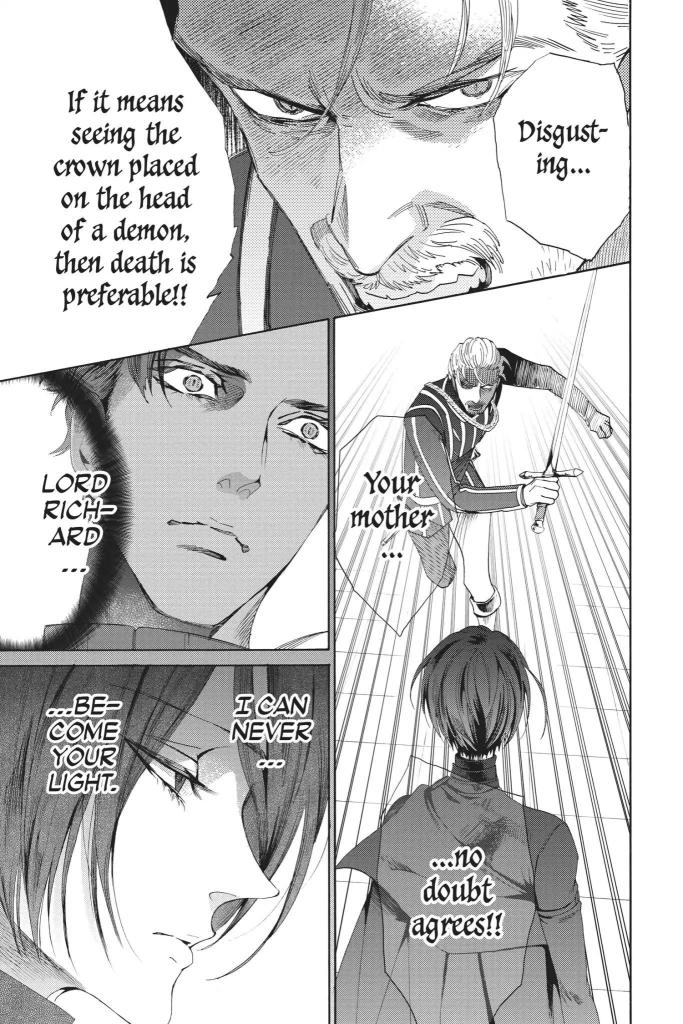

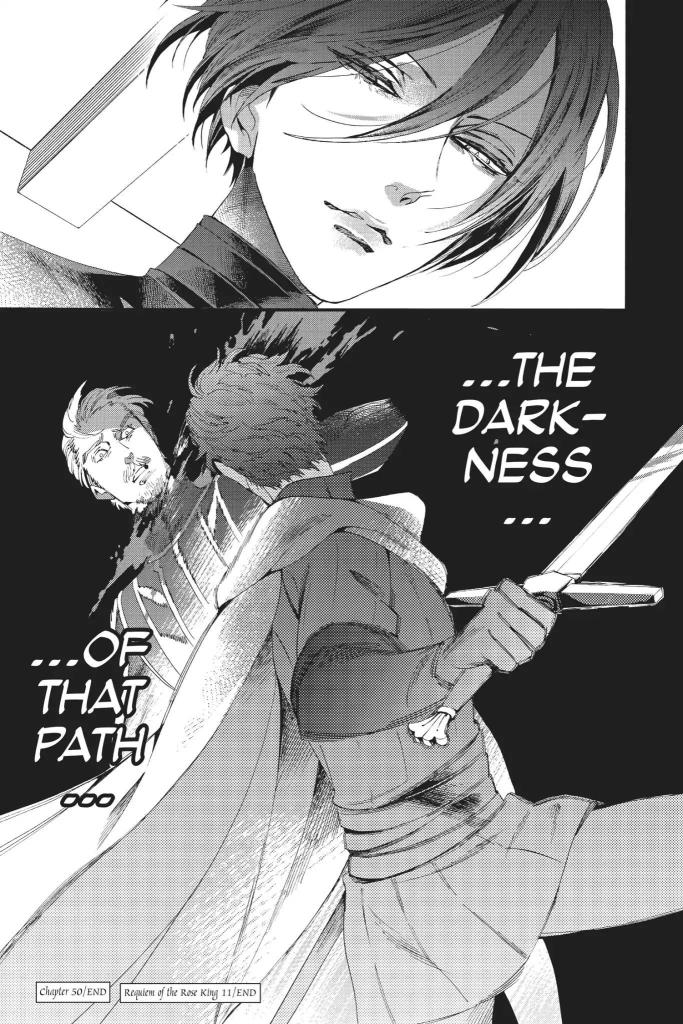
In Chapter 50, Vol. 11, Catesby chooses to protect his king and displays, yet again, his sincere loyalty that we’ve seen over the course of the work already. He never falters to typical vices, only to that of love for his King which we see in Episode 24 of the anime, which will likely be depicted similarly in Vol. 18 of the manga (whenever that comes out). If, as the anime shows us, Catesby makes the same decision to disobey orders and break his vow to save Richard III from the battle field then I would say that Catesby is a true “knight” living up to the archetype. However, even though we see this moment from Catesby’s perspective and even though we’ve seen Catesby grow over the course of the series, it’s hard to say if he fully meets the definition of the Knight until we see it in print because the anime does not fully flesh out the story in the same way that the manga has. Moreover, we never really question Catesby’s loyalty and, frankly, neither does Richard III. Catesby never reveals his love, we don’t see him planning to betray Richard III’s plans at the end, and so on. Catesby’s love is unambiguous. He’s chosen selfishness/love for his king in the end, and so–in a way–still never breaks his vows.
So… yeah. A noble, a king, and a mage are sometimes easy to define by literary means. However, a knight is a difficult thing and one I am struggling to find a proper comparison for despite having a multitude of knights to choose from and hopefully that now makes sense to all of you reading this. I’ll keep on the lookout though!
Thanks for reading!
Copyedited by: Krow Smith | @coffeewithkrow
Discover more from The Anime View
Subscribe to get the latest posts sent to your email.

One thought on “[Concept Analysis] Knighthood: It’s Complicated – A Broad Overview of Knights”