

By: Krow Smith | @coffeewithkrow
Today (13 October 2024) marks my one-year anniversary of being diagnosed with Dissociative Identity Disorder (DID), formerly known as “Multiple Personality Disorder.” Including the time before my diagnosis, it has taken me years to come to terms with being plural* and it isn’t something I’m public about. However, my fear of judgment shouldn’t keep me from an attempt to help de-stigmatize DID/plurality* for those who don’t know about it or have the wrong idea.
So when Peggy (@pswediting) told me that she is reminded of Yu-Gi-Oh! whenever I’ve talked about my experience, I figured I should look into it more. After all, it’d been so many years since I watched it last. Upon her recommendation, I started with Season 0 and found more than enough examples I could relate to!
However, before we jump in, I feel a few disclaimers are warranted. I am not trying to diagnose Yugi as having DID and I’m not saying that the story is about DID. What I’ll be talking about in this post is how I personally relate to Yugi Muto as someone with DID and not as an expert in the field. I’ll be discussing the similarities in our experiences and using him as a jumping-off point of what DID/plurality could look like. Also, all of the episodes I’ll be referencing are from Season 0 alone. Nothing from Season 1, 2, or beyond.
Lastly, I’ll be using a lot of terminology and phrasing that is regularly used for people who are plural. So there will be a glossary of common terms—some terms I use in this post and some I don’t—at the end for educational purposes. There will be an asterisk, like the first appearance of “plural*” above, to notify when a word or phrase is defined in the glossary.
Separate Identity
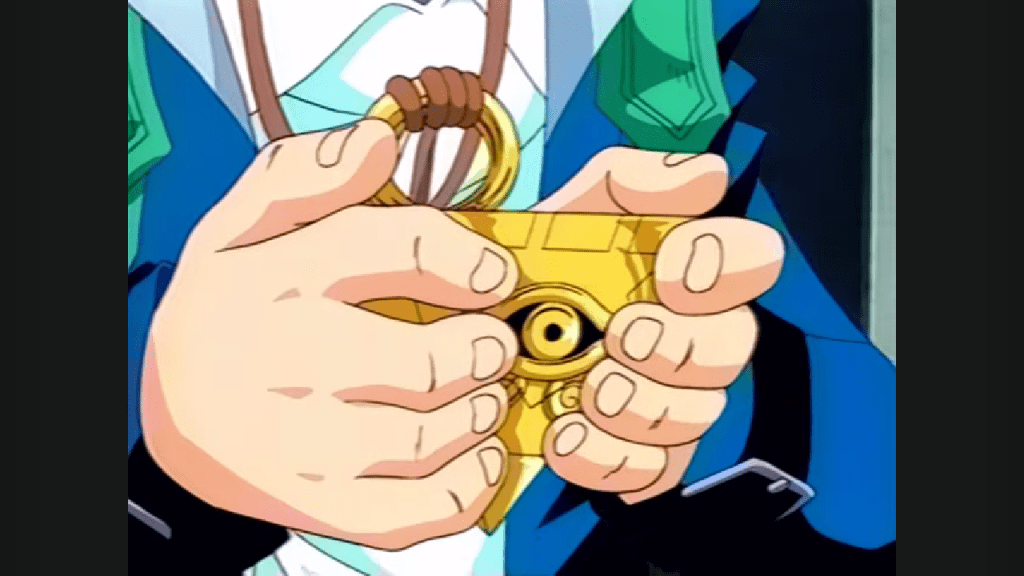
Most importantly, there is Yugi and there is Yami, two very different people. A major part of plurality is having two or more distinct identities or alters*. These alters have their own likes, dislikes, beliefs, opinions, etc. Of course, like with anyone, you can have many things in common, but the alters are still their own people.
An example of this is that Yami will do things that Yugi would not agree to. Things that Yugi would consider too cruel. Such as sending people to the hospital due to extreme shock as they hallucinate being eaten alive (Episode 1). Yugi would feel an immense amount of guilt if he knew that a part of him had done such a thing, regardless of the fact that the person it is happening to is the Villain of the Week.
Yami is reminiscent of a protector* alter. This is a term used to better understand an alter’s potential role* in the system*. A protector is like a guard for the system as a whole or specific parts of it. They also appear to be more confident as they are more capable of handling situations others in the system may not feel they can deal with. This is exemplified whenever Yugi or his friends are in danger: Yami appears and takes control of the situation as he does his best to help protect the others from further harm.
However, Yami also reminds me of a persecutor* alter. Persecutors tend to attack, manipulate, and/or control those inside of the system, but they can also do the same to those outside of it. All in an attempt to protect the system in their own, misguided way. Yami likes to have the upper hand over others when playing games and will manipulate his opponent (Episode 19) or his surroundings (Episode 12) in order to win. Also, while his punishments are severe, he shows no mercy towards those he deems to deserve such brutality. A fact Yugi is shielded from as he has no memory of Yami’s actions.
Amnesia
These lapses in memory caused by Yami fronting* are hugely relatable as it is a very common symptom of DID. When talking to people with such severe dissociation*, you’ll often hear about their experience with “losing time.” One moment, it’s morning while the next it’s suddenly midnight. This is caused by another alter or other alters fronting during that time.
However, these blackouts aren’t always so cut and dry. Sometimes, they’re more like “gray outs,” where you lose time but you might have a vague, blurred understanding of what happened. As I’ve gotten older and had more therapy, these gray outs tend to happen more often than full on black outs.

Inner World
In Episode 5, a character named Shadi uses his Millennium Key to peer into Yugi’s “Room of Soul,” in order to see if he has the power of darkness from the Millennium Puzzle. As he was inside, there was a hallway with two rooms on either side, unusual as people typically only have one room. On one side, it was an open door with toys strewn about and not even a tinge of malice in sight. While the other room had its door closed with Yami standing inside of it.
This scene was strange but exciting to see. I could personally relate to this as being like the inner world* of the system. An inner world (also known as a headspace) is a mental space where alters can appear and interact with each other and their internal surroundings. They can range in size and complexity and they can be as simple as a room with a couch or be an entire world. It differs from person to person!
For us, our inner world is like an apartment set within a similar void-like space, with a living room that serves as a communal area and it has connecting hallways and bedrooms for each alter. So it was quite jarring to watch as I felt seen in a way I’ve never experienced before. I feel most media doesn’t cover the headspace at all, leaving out a huge chunk of representation for those that are multiple. Thus, denying an opportunity for people to feel truly seen and to better explain what their experience is like.

Denial and Acceptance
In Episode 23, Yugi tells his friends about this “other [him]” he’s been trying to keep inside, how he loses time, and how he’s been keeping it a secret because he was afraid his friends would leave him if they found out. After the encouraging words from his friends, Yugi is about to battle Mokuba Kaiba when he says, “I’m no longer afraid of the other me,” then voluntarily switches* to Yami. This showcases the denial Yugi had been going through before he was finally able to accept this other part along with his friends.
Denial is something that haunts a lot of people who are plural, even after getting an official diagnosis. While there can be a host of reasons why this happens, the fear of the stigma and of losing those around them can be huge contributors. However, having a support system that is open to them and all of the alters can help them begin to come to terms with their multiplicity* and with that acceptance comes healing.
For me, denial also came about because I had to acknowledge that these alters are real and how we were functioning was disordered. It can be difficult to admit when there’s a problem, let alone a problem that can initially feel too abstract to comprehend. I was dealing with being multiple largely on my own for so long that it became exhausting and too isolating to hide anymore.
Much like Yugi in Episode 23, I couldn’t continue keeping this secret despite my fears of rejection and abandonment. As certain alters were making decisions I wouldn’t make or picking arguments that I wouldn’t have had otherwise. It was deeply distressing to hear that people’s perceptions of me were changing for reasons I had no part in or couldn’t even remember in the first place. However, I am lucky as those I’m close with, that I told, have accepted me and all of the other alters (giving me the strength to make this post!).
Not everyone can have that luxury, though. It is a very real possibility that friends or family might distance themselves after learning that their loved one is plural. That, or outright accuse the person of lying for attention. This is why some people decide not to tell anyone and continue living covertly, keeping it a secret from those they are closest to, even their partner.
Romantic Relationships
On the note of romantic relationships, it has come to my understanding that “puzzle shipping” is a thing in the Yu-Gi-Oh! fanbase. This is when people ship Yugi with Yami together romantically. While the thought of this shipping puts a bad taste in my mouth because I see them more as sharing a platonic partnership, it does bring up an interesting question for those not familiar with multiplicity: “Can alters be in romantic relationships?” The answer is yes!
It is quite common for alters to fall in love with each other and start a relationship. Think of it as something like a long distance relationship. When one of the alters is out in the world, they can’t physically see or feel the other in person but they can communicate in a multitude of ways (internal communication, messages, gift-giving, etc). This, with the addition of having the inner world to interact together, can lead to a fulfilling and even healing relationship with one another.

Healing
The show aside, with multiplicity, there are two different results you can aim for in healing. One is called “final fusion” and it is when all dissociative barriers are lowered between alters and they fully blend and integrate* together to form one unit. After final fusion, it takes time and effort to continue as one. However, after a certain amount of time it is said that your chances of separating are significantly minimized.
The other option is called “functional multiplicity,” this is where parts integrate somewhat, lowering dissociative barriers, and work together to function as multiple people. This is the one I hope to achieve some day. However, no option is more correct than the other and it is a deeply personal choice for those who are plural to make.

Conclusion
Overlooking the mysticism and the creative liberties, I feel that Yugi and Yami are interesting examples of what plurality can look like. I believe they are a solid representation in a sea of violently stigmatic portrayals in the media, like the movie Split. I highly recommend watching Season 0, not only to experience how different it is from the rest of the series, but to see—and perhaps relate to—how it resembles plurality.
Thank you for reading! I hope you’ve found this to be informative. This post means a lot to me, so if you enjoyed it please consider liking it!
Glossary
Alter: A dissociated self state/alternate identity; To refer to an alter as a “personality” is outdated and incorrect
Body: How the shared, physical body is referred to as; Example sentence, “The body’s age is different than some of the alters’ ages”
Caretaker/Soother: A role in the system; An alter that takes care of some parts of the system (especially child alters)
Child Alter/Little: A type of alter that is younger; Typically acts younger but can still understand big words or abstract concepts; Not all littles want to be treated as children
Co-Con: When two or more alters are “co-conscious” or fronting together
Dissociation: the process in which the brain is disconnected from thoughts, feelings, memories, or a sense of identity
Fragment: An underdeveloped alter that holds one specific memory or emotion
Fronting: The act of an alter or alters being in control of the body
Fusion: The act of fully integrating two/some/all alters into one being
Gatekeeper: A role in the system; An alter that can control switching, access to certain areas in headspace, and/or certain memories and information
Host: A role in the system; An alter who fronts the most; A system can have multiple hosts/co-hosts and hosts can change; To refer to the host as the “core” identity is incorrect
Inner World/Headspace: A mental space used for alters to interact with each other and their internal surroundings
Integration: The process of bringing down dissociative barriers, sharing memories, and heightening communication between alters; Some form of integration is necessary for healing and won’t always result in fusion
Introject: An alter that is based on a real person or fictional character; Known as a “Factive” when the source is reality based (like a family member) and a “Fictive” when the source is fictional (like a character in a movie or TV show)
Middle: Slang for an alter that is of teenage age
Multiplicity/Plurality: The experience of being multiple people or having multiple distinct identities
Passive Influence: The experience of an alter inadvertently affecting the one fronting; Could be with emotions, thoughts, mannerisms, cravings, etc.
People Who Are Multiple/Plural: Those who have more than one distinct identity; Not everyone can get a diagnosis, so these phrases help to be more inclusive
Persecutor: A role in the system; An alter that uses negative and potentially harmful tactics in a misguided attempt to protect the system; Misunderstood as being “bad” or “evil”
Protector: A role in the system; A guard for the system as a whole or a part of the system
Role: An alter’s job in the system; Not all alters have a role and not all systems define their alters as having roles, as some believe it can be reductive
Splitting: The act of a new alter forming
Sub-System: A system within a system; Could be an alter with their own system or a separate collective of alters not in contact with the main system
Switching: The act of changing which alter or alters is/are fronting; Most people who are plural can’t control it; When happening between multiple alters in quick succession it is called “Rapid Switching”
System: A group of alters
Trauma Holder: A role in the system; An alter that holds traumatic memories in order to protect the rest of the system from that trauma
Developmental edits by: Peggy Sue Wood | @pswediting
Copyedits by: Kathy Cañeba | @kcserinlee
Discover more from The Anime View
Subscribe to get the latest posts sent to your email.

2 thoughts on “[Analysis] Yu-Gi-Oh! and DID/Plurality”