

By: Peggy Sue Wood | @pswediting
I believe people often underestimate the significance of purpose within individual scenes in a story. I wouldn’t go as far as to suggest that every single aspect in a story must directly contribute to the overarching narrative–that would be overly restrictive and neglect the importance of other elements, like dialogue, in shaping reader comprehension–however, purpose remains a crucial factor in determining a scene’s value and relevance, especially in visual storytelling.
Consider, for instance, the role of establishing panels or scenes, which serve to establish setting and scope, or interactions between minor characters that offer broader context to the narrative. For instance, in Shakespeare’s Romeo and Juliet, the play doesn’t immediately open with the Capulet and Montague families. Instead, it begins with their servants arguing in the street, offering the audience a glimpse into the extent of these two families’ influence within the town and the depth of their rivalries. These examples highlight how purpose drives the effectiveness and significance of individual scenes, ultimately enriching the overall storytelling experience.
Reflecting on this idea reminded me of what makes certain scenes stand out as my favorites, which I think applies to many others. One of my favorite scenes, for example, can be found in Chapter 185 in the Solo Leveling comic wherein Kim Chul reacts to encountering Sung Jinwoo post time jump for the first time. I especially love this scene as we see how conflicted he is emotionally, and seeing as the shadow warriors around Jinwoo celebrate the return of their old friend “Iron.” This scene, nestled within the falling action of the epic, adds a touch of humor and warmth. It made me realize that scenes like this resonate deeply when they hold significant meaning, whether it’s contextual or emotional.
This reflection brought to mind another cherished scene from the manga for I’ll Become a Villainess That Will Go Down in History, which is currently airing its first animated season. While I’m unsure if the scene I’m about to describe will be animated, it certainly deserves recognition for its impact. (I’m referring specifically to the concluding chapter of Volume 3, where the supporting cast evaluates the main character, Alicia, in comparison to Liz, the “rival” within the story. Rather than chapter, it might be better to call this a chapter addition or omake, but I’m not 100% certain so we’ll just call it Chapter 15.5, okay?)
Volume 3 undergoes a notable shift, a topic I explored briefly in my recommendation about the series last September, considering how light hearted the first two volumes were. This short entry at the end of the volume is no exception, and actually adds a lot more to the story’s developing theme which contrasts an “ideal” world versus “reality.” Through this scene, the creator(s) provide a look at the balance political challenges require in the text itself—something I rarely see explored thoroughly within a romance-based reincarnation/transmigration story like this.
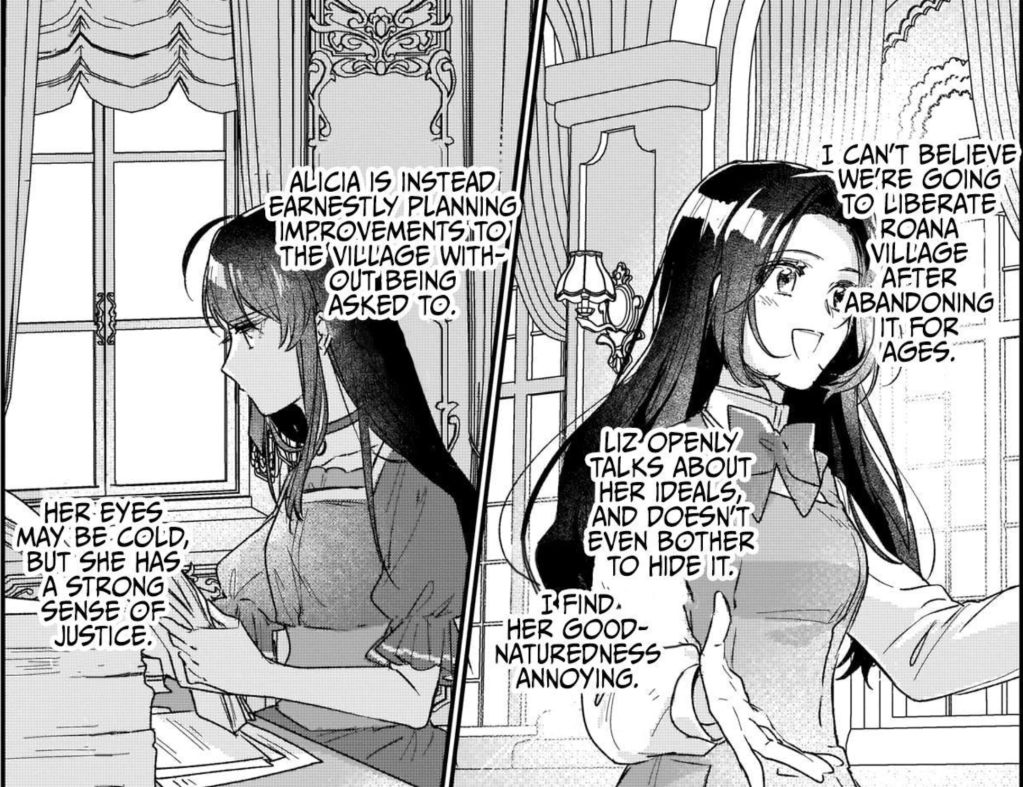
If you watch a lot of political dramas or commentary, you may know that usually there is a “face” to an idea and then there are the people actually behind it. Consider, for instance, a significant breakthrough in the medical field, such as the invention of soap (I’m providing an exaggerated take on this, bare with me). While researchers can attest to its efficacy in saving lives when used correctly, convincing the public of its benefits—especially considering its composition largely of animal fat—poses a considerable challenge. Moreover, what may be a well-supported research paper doesn’t necessarily translate into a captivating news story or advertisement.
To effectively disseminate such information, it’s necessary to tailor it for different audiences. This involves employing individuals skilled at communicating complex concepts in terms people unfamiliar with jargon can understand and enlisting charismatic figures to endorse and promote it. This might entail making announcements, organizing public speaking events—activities that researchers may not excel at but which actors and marketing professionals are adept. The creators subtly touch upon these dynamics in Chapter 15.5 by contrasting Liz and Alicia’s approaches to the same issue.
Liz, characterized as an idealist, often lacks foresight and relies on situations resolving themselves. Consequently, she hasn’t honed her problem-solving skills. Instead, she leans on emotional persuasion and her public persona as a humanitarian to garner support. However, pathos-centered arguments aren’t going to work for everyone, particularly where financing and complex overlapping factors may apply. That’s where Alicia, our pragmatic realist comes in. She’s much more skilled at solving things through research and hard work. Her logos-centered arguments and approach are what will get the job done. You need both aspects, however, to make something happen.
Consider the balance required in garnering support: why would people invest in someone they don’t trust? Moreover, why do people tend to choose a likable personality over unlikable competence? There has to be a balance, and the creators of this series show this nuance through this brief and subtle exploration.
I especially like how the creators, through the various supporting cast of characters discussing this contrast/comparison of Liz and Alicia, acknowledge the diverse perspectives people hold regarding these ideas, offering a rich layer of depth to the story. Not everyone, such as Jill and one of Alicia’s brothers, will like or appreciate Liz’s approach to the cricis in Roana Village. Likewise, others may find fault in Alicia’s blunt assessment of the situation’s complexities and costs when presenting solutions, even if that information is ultimately more likely to win the support of the parties tasked with funding a solution.
This scene serves a pivotal purpose in propelling the narrative forward, prompting readers to contemplate its implications for the future. It’s precisely this depth and exploration of contrasting perspectives that make it one of my favorite scenes in the story thus far—an aspect I hope those of you reading this can also appreciate.
So, with that in mind, what are some of your favorite scenes from a series? And, what was it that made them so memorable to you? I’d like to know! Please share in the comments below.
Discover more from The Anime View
Subscribe to get the latest posts sent to your email.
