

By: Anonymous | @tavmedia
MATURE CONTENT WARNING – This post contains content that we at The Anime View do not think is suitable for everyone. Subjects and possible triggers in the work being discussed and mentioned in this post include assault and pseudo-incest. By clicking “Read More,” you understand that you will encounter such content. Viewer/reader discretion is advised.
Totally Captivated is a Korean yaoi manhwa that has been around since the mid 2000s. It started publishing 2007, concluded by 2009, and has since circled the web through multiple platforms for official release, including Lezhin US, Mangatoon, Net Comics (6 Vols -Digital & Print- Complete), Pocket Comics, and Toomics. It is one of those series that seems to be everywhere, but nobody talks about it.
Its continued popularity (circulation?) is an interesting one to me as the series has high reviews but would not be considered a “good” romance by modern standards. Today I want to discuss it, because context is everything.
So, let’s start with the story: Totally Captivated follows the tumultuous relationship between Ewon Jung, a former player, and Mookyul Eun, a powerful boss in a pseudo-gangster setting. The start is somewhat comedic, with Ewon forced to work under Mookyul as a result of his ex-boyfriend, Jiho Shin (Mookyul’s current friend with benefits), wanting revenge for being cheated on. Ewon soon finds himself entangled in the dangerous and unpredictable world of Mookyul, who’s business practices are close to criminal. As the story progresses, Jiho and Mookyul break their relationship, while Ewon and Mookyul begin their own. However, the comedy starts to shift as more and more serious subject matters take part in the plot as the 6 volume series and 3 volume doujinshi (dj/djs) continuation create a complex drama that starts to show how these two could end up together.
One piece I love is Ewon’s confession towards Mookyul while sick, telling him that he is like the chocolate on a birthday cake: something you want, but something that will disappear. Later, that comes back when Mookyul claims they’re in a relationship which Ewon denies it, only for Mookyul to follow up with, “I’m your fucking chocolate!” That aside, if Ewon wasn’t such a playboy, he’d be too good for Mookyul.
The guy is practically the best in every way as a stellar cook, a professional level cleaner, and scholarship college student. Mookyul, a thug with a good face, wouldn’t match up. However, you get to learn more about them and find that Ewon isn’t just a player—he’s broken and so is Mookyul. They knew each other briefly as middle schoolers, and around then Ewon was going through his own troubles. Mookyul was too. The differences are that Mookyul got support—toxic support, but support nonetheless. Meanwhile, Ewon was on his own.
Both learned to use their body to get what they needed, with Mookyul securing himself a home in a pseudo-gangster business and Ewon gaining temporary support over the years, and the more we learn about these sides to them, the more the toxic elements of their story start to add up into a romance based on healing.
Ewon, a player, is dependent on people liking him. He’s needed it to survive and was deprived of such things as a child. Mookyul, a boss-level badass, didn’t have to rely on others and, when he did, he gained them through his own means rather than through a dependance. Thus, choosing to long only for the Ewon he met as a child who “waited” for him in order to keep his own pride and mental strength in-tact.
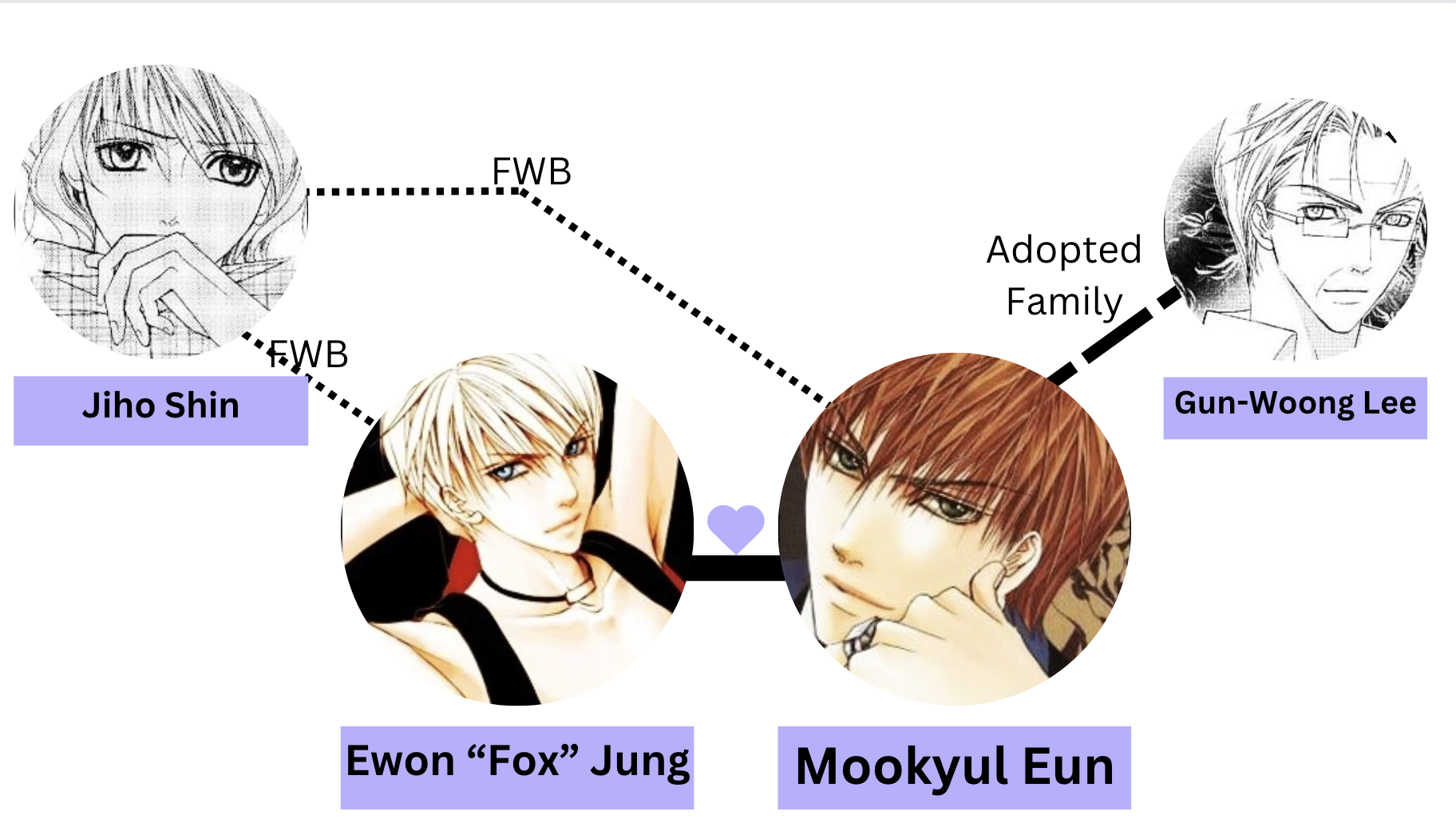
When the two finally come together around Volume 3, they’ve spent the first two volumes showing how dysfunctional they are as individuals to the audience, as well as their chances for redemption. Ewon is a philanderer, but he really does care about Jiho and shows how scared he is of the idea of committing so much of yourself to one person (which, makes sense given his childhood—spoilers I won’t get into). Mookyul, meanwhile, is shown to be an ill-tempered “beast” but one that really does want a serious relationship and is willing to work towards that and control himself (to a degree) to get what he wants.
Once the two finally are together, they can start to grow and we see Ewon and Mookyul undergo significant character development from that point forward, making them more endearing to readers. The nuanced exploration of their personalities and vulnerabilities adds depth to the narrative, making the romance all the more compelling. Despite the rough backdrop of how pushy and controlling Mookyul sometimes is only to have that pushiness confirmed as a necessity for the continued growth of the relationship by how Ewon has to break his player-habits.
However, the comedic, classic yaoi approach to the story that was typical of yaoi emerging at the time (and sometimes still now) for gangster x playboy takes a really dark turn in Vol. 4 with Mookyul going too far and forcing himself on Ewon. Ewon forgives it, as it was a peak emotional moment between the two, but it really shows how that toxicity in the relationship isn’t gone yet. That the comedy is fluffing it up, but that they are, deep down, still broken people that are learning to heal. That comes up again in Vol. 5 when the two fight and break up. Ewon is finally willing to take that final step of devotion to one person, but not unless Mookyul does the same by letting go of his adoptive father—a man he’s called father all throughout but who we learn has been sleeping with Mookyul for sometime.
It is a brutal confrontation, with Ewon learning now what Jiho felt in the betrayal of cheating from Volume 1, while Mookyul comes to learn that if his adoptive father is really a father figure, then leaving him for Ewon is a step in the right direction for becoming an adult.
With Mookyul learning that what Ewon says is true, that if you want someone to be yours only and to sacrifice something important to them the way that Ewon has sacrificed certain friendships and personal freedoms to appease your anxiety, then you need to make that same step of sacrificing to appease their anxieties.
This comes out more in the associated doujinshi by the same author and published officially, which some may or may not include in the canon (but I will). In the djs, we learn more about how the relationship between Mookyul and his adoptive father concluded after the main storyline’s ending. The author details how Mookyul’s perspective is a bit warped and how the adoptive father’s is as well. They don’t see each other as lovers, even if outsiders might. It doesn’t change the physical aspect, but the clarity, at least from an emotional standpoint, does help the reader in understanding why Mookyul and Ewon are not on the same page for so long about this aspect of their relationship.
While some say that the major themes for this story are love, redemption, and self-discovery, I would say that the major themes is more simply defined as love. Not the pure kind of love you see in romances blinded by rose colored glasses, but one that builds a message on how much work has to go into a relationship to function in a healthy way. It’s not just about the physical or light apologies or handing over money and thinking everything is alright. It’s about finding a middle-ground for understanding, about giving up what you may like for what you really want, and learning to let go of the bad things that are holding you back from finding happiness elsewhere.
Personally, I like this series and it is cool to see it continue to pop up on different platforms. It is a testament to the series lasting appeal to readers, which is why I’m surprised it hasn’t sparked more discussion.
Well, that’s all from me. If you read it, please share your thoughts in the comments below.
Developmental edits by: Krow Smith | @coffeewithkrow and Peggy Sue Wood | @pswediting
Discover more from The Anime View
Subscribe to get the latest posts sent to your email.
