
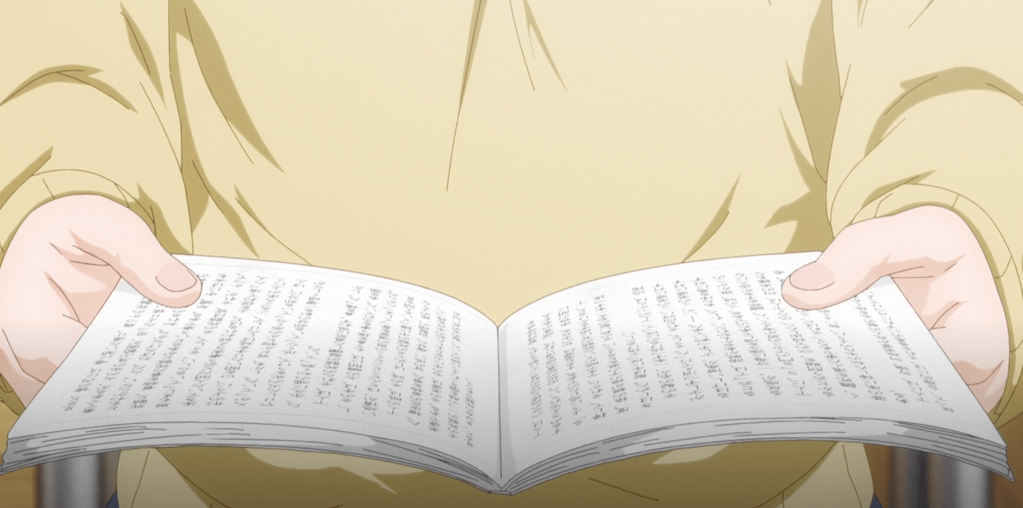
When I first wrote about Mieruko-chan last year, I couldn’t stop thinking about the classroom scene in Episode 1 where the teacher asks, “What do you think is the author’s intent? Imagine if you turned into a tiger. What is it like to have part of your humanity stripped away?” (MIERUKO-CHAN, Episode 1)
As we now know, or assume, this is a reference to “The Beast Beneath the Moonlight” (Tsuki ni Hoeru Kemono, often translated as “The Moon Over the Mountain”) by Atsushi Nakajima and understanding this confirms what I wrote about Mieruko’s story back then.
Nakajima’s story follows a scholar who gradually transforms into a tiger as a result of his changed mental state (or “madness”). It is a change that occurs both to his body and mind, which he believes also changes his soul. It’s a tale about isolation and alienation from people and friends, about identity, and also about the tension between reason and instinct. The man becomes something wild and estranged from the human world he knew before, not because he wants to, but because something deep within him has changed.
This is, in many ways, what happens to Mieruko. From the very first episode, her ability to “see” spirits separates her from everyone else and she’s unable to talk about it. Her silence and her practiced denial become the marks of someone slowly being devoured by another reality. She’s not going mad, as the scholar says he did in his own words, but she is undergoing a change that is uncontrollable to her in the same way as the man who became a tiger did.
As the scholar says to his former friend in the story:
“When I was a man, I did my best to avoid contact with others. People thought me arrogant and self-important. They did not realize it was, rather, shyness that made me act that way. Of course I was not without pride in my old reputation as a prodigy among the boys of my hometown. But it was a timid kind of pride: I hoped to make a name for myself as a poet, but I never attached myself to a teacher or sought out the company of other poets who might have helped me to improve my skill. At the same time, I had no intention of ranking myself together with the common, unpoetic herd. But this was the result of my timid pride and a disdainful shyness. Fearing that I might not be a jewel, I made no effort to polish myself; but half-believing that I might be a jewel, I could not rest content among the common clay” (Nakajima 6).
This confession reveals the scholar’s tragic self-awareness about his own isolation. While some might have believed (as was hinted to at the beginning of the story) it came from a complex of superiority, it really stems from fear, pride, and vulnerability intertwined within the speaker. He withdrew from others not out of disdain, but out of a fragile sense of self that he could not bring himself to show others. In that tension between pride and fear, between wanting to belong and fearing inadequacy, there is a lot here that overlaps with Mieruko.
She (or really, her silence) operates in a similar emotional space. Her withdrawal is self-protective, but it also deepens her isolation. Like the scholar, she hides her fear behind composure, pretending nothing is wrong in order to preserve, firstly, herself from the unknown but also her sense of normalcy that is becoming ever more fragile. Yet this very act distances her from others (her family, her friends, and even herself).
Both characters, then, are consumed by the quiet tragedy of knowing too much about their own states and saying too little. They fail to reach out for help in the early stages, when they need it most. Even though Mieruko does eventually seek some form of help, she never directly asks those who might truly understand; instead, she accepts aid that she happens upon later (much like the scholar who asks a former friend to pass along his poetry).
The scholar becomes a tiger because his inner struggles to become who he wants devours him from within. Mieruko, in contrast, remains in a state of transformation. She is acutely aware of the monstrous and the unseen world around her and how it reshapes her perception of reality. Her silence becomes a mask that protects her humanity but also distances her from it, as she grows increasingly isolated and unable to speak about what she experiences.
Revisiting that classroom scene with Nakajima in mind, the teacher’s question takes on a deeper meaning. As I said before, I think that this narrative is one where Mieruko’s humanity, specifically her ability to interact and function normally in the world, gradually erodes over time like the man who becomes a tiger.
We already see how much this transformation affects her internally. So what happens when she finally sees too much? When it’s gone so far that she can no longer explain it or when she changes beyond recognition before she’s finally able to speak?
Later, in Episode 10, when the class reads Akutagawa’s Rashōmon, we again see a literary mirror, this time exploring moral ambiguity and human frailty. As I wrote then, still true now, “[t]he end of “Rashōmon,” in the English translation, reads as follows, “‘Beyond this was only darkness… unknowing and unknown,’ which describes what a character [in the work] sees when looking out into the streets. This is sort of where Mieruko’s story ends off in Season 1 as the audience and Mieruko herself are left in darkness, looking out into the unknown with unknowing eyes.”
Together, Nakajima and Akutagawa function within the anime as an intertextual pair: one examining the transformation of self, the other the corruption of moral certainty as a result of seeing too much. In overlapping with Mieruko’s story, these references show how her terrifying and absurd situation is not merely comedic, despite its surface-level humor. This is a horror that goes beyond jump scares. The literary allusions foreshadow Mieruko’s transformation into a kind of tiger—a powerful being capable of facing the unknown and confronting terrifying forces, yet one increasingly cut off from human connection and at risk of losing herself to that very transformation.
At least, that’s what I think… what about you? Let me know in the comments below!
—
Read “The Moon Over the Mountain” by Atsushi Nakajima here, if interested: https://www.scribd.com/document/561974360/Nakajima-Atsushi-The-Moon-Over-the-Mountain
–
If you enjoyed this post, please consider buying us a coffee, leaving a comment, and/or subscribing to us below!
Copyedited by: Katherine Cañeba | @kcserinlee
Discover more from The Anime View
Subscribe to get the latest posts sent to your email.
