
By: Adam Goldin
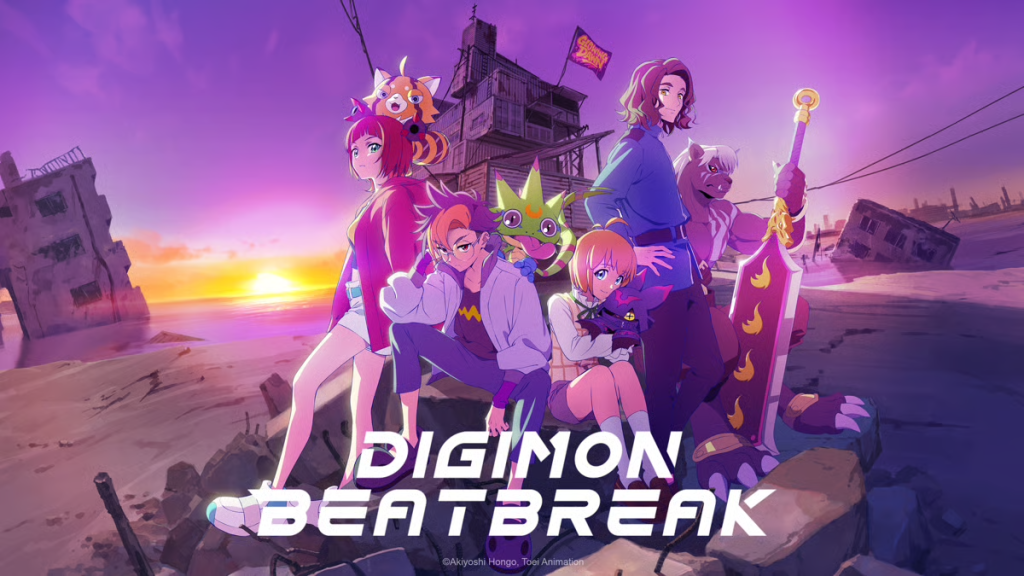
In Saban Entertainment’s latest entry for the Digimon franchise, Digimon Beatbreak, we can see first hand the problems with overreliance on Artificial Intelligence (AI) technology conveyed largely through the character of Tomoro and his Digimon, Gekkomon. In the real world, an overreliance on AI is destroying the ability for humans to think critically as well as the environment we live in. Ultimately, I feel the show is aiming to convey to the audience how to interact with AI in a healthy way by showing the issues with over use of Artificial Intelligence in search of an easier life through this season.
As of writing this post, the show boasts a seven-episode run with more episodes releasing on a weekly basis. The show argues for a distrust of Artificial Intelligence and being critical of systems in place. While the show is still very much an entry in the Digimon series, under its beautiful fight choreography there is a story of a young, impoverished boy who lost his only family and gets adopted by a group of Digimon bounty hunters where he finds a family, questions technocratic rule, and discovers his identity through his own personal strife and interacting with his Digimon.
The show is set up by explaining the unique interaction between Digimon and their partners. To grossly oversimplify, the Digimon are a virus that infects a Sapotama, a device that functions as both a cellphone and digital identification card. The Digimon then feed on their partner’s life force, referred to as E-Pulse. The Digimon actively take the energy from their environment, which—in this case—is their partner. This premise is akin to generative AI slowly destroying the environment by consuming important, often massive amounts of energy for very little output by way of increasing resource draw.
As it stands, the environmental impacts of Generative AI output are projected to exceed 1000 megawatts of energy by 2026. For context, the average American household takes 1200 watts to power continuously for a year. 1 megawatt is 1,000,000 watts. A quick calculation shows that the energy it takes to run 1 Generative AI model could power a billion homes for a year. The main character, Tomoro Tenma, gets partnered with Gekkomon, a boisterous, gluttonous Digimon that—as its name would suggest—roughly resembles a gecko. Digimon are mirrored versions of their partner as they feed off their partner’s E-Pulse, it changes the Digimon’s personality traits. As a parallel to the show, AI models changing their responses to situations based on the user’s input is the main draw of LLM (Large Language Models), such as ChatGPT, Gemini, and Siri. The effects of this are twofold, they make the AI seem like a friend and give the AI the ability to trap the user into a “conversation.”
The Digimon not only feed on the life force of their partner and destroy them from the inside out but they also have the capability to directly harm their human partner. While this has not been shown in this season, we have seen antagonistic Digimon that do not seem to care whether or not they hurt people, which parallels people’s tendencies to heavily rely on their fastest and easiest explanation at the cost of our environment.
This sets the stage for an interesting examination into Tomoro’s character, as what we know about him at this point is what we see through flashbacks with the few characterizing moments the show has been able to slip into its short run. He was characterized as an aloof and nonchalant, wannabe rockstar who couldn’t care less about adventure or anything unless his brother was there. Unfortunately, in Episode 1, Tomoro’s brother, Asuka, is put into a vegetative state due to the illness known as “Cold Heart” and in that moment Tomoro ceases to care about anything.
Now that we have a working understanding of the plot up to this point, and the premise of my argument, we can address the meaning behind the imagery. The show poses a theory of overreliance on technology as none of the characters up to this point in the series have been able to solve a problem without the use of their Digimon partner’s abilities. This could be something as small as fishing for dinner, carrying objects, or interpersonal arguments.

From the start of the series, the Sapotama is framed as the perfect device that is indispensable for daily life in the unnamed futuristic Japanese society. This device, as previously stated, functions as a digital identification and a tool to access societal functions. In Episode 1, the characters have to check into school using the Sapotama. It is an extremely common device, yet—notably—Tomoro refuses to use his Sapotama unless he has to do so. He even goes as far to state his distaste for technology and Artificial Intelligence. This creates an interesting frame for his relationship to Gekkomon and ultimately himself.
He is the protagonist of a series predicated around digital monsters who inhabit a digital landscape that does not trust “modern” technology, and refuses to use it where possible. Tomoro’s distrust of technology both in canon and in our world would make him a social pariah and yet, in a world where technology rules all and solves all of life’s problems, the most interesting story to tell is about a guy who doesn’t want to use it.
While this is not unheard of and can be seen in works such as Fahrenheit 451, amongst others, what those works lack is timeliness. Every day, human beings are inundated with AI nonsense, as it infiltrates everything we use by being in Google searches, in Microsoft Word even, and sometimes it’s in the browser itself without the ability to turn it off. I would even go so far as to argue that a lot of people cannot do basic fact-finding without using AI, which has been proven wrong multiple times.
I propose that Tomoro and, to a lesser extent, his crew, represent a population that is not only distrustful of Artificial Intelligence, but is critical of it as well. The criticality of AI is paramount not only to his character, but sets up a conversation that I believe needs to happen amongst people.
At best, tools like Grok, ChatGPT, and Copilot are tools that can speed up workflow; at worst they are predatory programs that are killing the planet and reducing our ability to critically think. To think critically, much like Tomoro continually questioning the intentions of his own Digimon and the people who rely on their Digimon, we as people need to directly question what information is fed to us by our devices. Generative AI may not be going anywhere, but we should be more critical of it and how we engage with this technology.
I believe that it is the job of all netizens to critically examine their relationships with any AI platform given. The destructive amount of energy it takes to run them and the massive amount of resources it takes to fuel them should be talked about more. While there are issues that platforms such as ChatGPT can resolve, using it too frequently is damaging to both the environment and the user’s intellectual capability. So put down the AI and focus on finding the choice that is right for you.
If you are interested in watching the series for yourself, it is currently being streamed exclusively on Crunchyroll with new episodes on Saturdays.
–
If you enjoyed this post, please consider buying us a coffee, leaving a comment, and/or subscribing to us below!
Developmental edits: Peggy Sue Wood | @pswediting and Krow Smith | @coffeewithkrow
Copyedited by: Katherine Cañeba | @kcserinlee
Discover more from The Anime View
Subscribe to get the latest posts sent to your email.
