
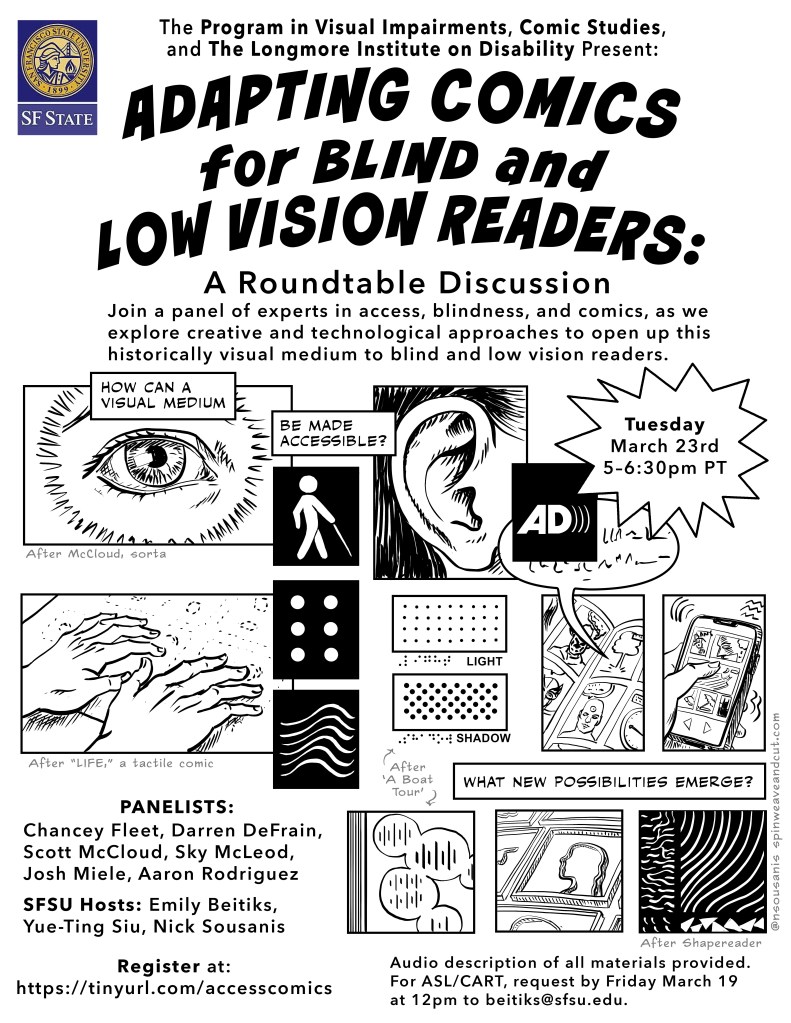
Poster for March 19 roundtable event – including list of panelists, organizers, event details. Comics-style panels that show some different ways comics are adapting for blind/low vision readers – including tactile, haptic, and audio
By: Peggy Sue Wood | @pswediting
I think most of you know by now that I’m very much a comics fan. I love discussing them, learning about them, and sharing them. Recently, I’ve also been hoping to teach comics formally in a class, and as part of the proposal process, I’ve started designing the course to create a proof of concept.
When I began planning the class, I had a few major goals. The most ambitious of which is that I want the course to be fully accessible and zero-cost—one that works for every student, to the best of my ability, including those with low vision and blindness. I assumed the biggest challenge would be selecting readings (and that has certainly been a major challenge). However, I was not expecting everything to be as challenging as it has been. Finding accessible texts that don’t violate copyright, assembling the proposal for my supervisors, and trying to stay within state requirements—all while preparing for the course approval process as ahead of time as possible to get this implemented in the near future—is proving to take much longer than I thought it would as someone who has consumed so much of the media in the last 10+ years.
I knew comics and graphic literature could pose challenges for blind and low-vision readers, but actually trying to build a reading list has made the difficulties and differences in accessibility much clearer. I’ve watched accessibility panels from various conferences available on YouTube. Each have been very insightful, but also revealing of new obstacles. For example, I’d love to have students read a Kodansha Sampler for a discussion board because it offers a variety of short chapters in one place. However, those samplers aren’t accessibility-friendly. I found another resource, “Innovations in Accessible Comics for Blind & Low Vision Readers,” but many of those comics, while valuable, aren’t visually engaging in the same way; moreover I don’t want to exclude my potentially low-vision and blind students from manga or other graphic-mediums that are also important considerations in the course.
The reality is that many comics don’t have alt text, image descriptions, tactile-friendly versions, or accessible adaptations. Some are locked behind steep paywalls, and many simply don’t exist in accessible formats at all. Or, if they do, those formats still miss essential elements. For example, I would love to assign Persepolis by Marjane Satrapi. We can provide copies through the library, and there’s an animated film adaptation (yay!), but many free accessibility options—like YouTube read-aloud—don’t include panel descriptions. All of this has resulted in many hours spent hunting for PDFs that screen readers can handle and finding alternative resources for students that won’t violate copyright. Also, because the course is trying to be zero-cost, identifying where to purchase accessible versions isn’t an option I’m including at the moment.
However, the search is paying off, albiet, slowly. I’ve begun uncovering resources that are opening doors, such as the Accessible Comics for the Blind Project, which creates detailed audio transcriptions and verbal renderings of comics. Their “Accessible Comics Resources” list has been especially helpful. The Comic Book Script Archive has allowed me to add at least one DC comic to the reading list thanks to its detailed script files.
These resources have given me renewed hope as I work on this course.
I’m still in the early stages of gathering readings, and progress is slower than expected. Each text needs to undergo accessibility checks, alternative-format planning, copyright consideration, and zero-cost verification. The course outline is evolving alongside the materials because, frankly, the materials are shaping what the course can be. While I know another school nearby teaches a similar class, after speaking with an instructor there, I learned it’s neither zero-cost nor accessibility-focused—so in many ways I’m building this from scratch.
Practically speaking, I’m not even sure the course will be approved. Moreover, I might have to give up on one (or both) of these ambitious goals. Like at many institutions, ours must consider enrollment and cost before launching new classes, and small or specialized courses can be a hard sell. Still, even with approval uncertain, this process has already reshaped how I think about course design and how I think about teaching comics. As challenging as it’s been, it has also been rewarding.
I’m still searching, still revising, still hoping for course approval in the future, but I’m also learning that designing an accessible class built around a visual medium requires persistence, creativity, and a willingness to rethink what a course can be for students. Slowly but surely, the reading list is coming together, and once that’s set, the rest should be smooth sailing!
Anyway—if you have any recommendations for accessible comics, resources, or approaches, I would sincerely appreciate them! I’m hoping to pitch this course in Spring 2026 for possible implementation in Fall 2026 or Spring 2027.
Fingers crossed, and I look forward to your suggestions.
–
If you enjoyed this post, please consider buying us a coffee, leaving a comment, and/or subscribing to us below!
Line edits by: Krow Smith | @coffeewithkrow
Copyedited by: Katherine Cañeba | @kcserinlee
Discover more from The Anime View
Subscribe to get the latest posts sent to your email.
