

[Anime Review] Dragon’s Dogma: Compare And Contrast
By: Krow Smith | @coffeewithkrow
Dragon’s Dogma: Dark Arisen is a game I hold near and dear to my heart. It is a Japanese action RPG in a high fantasy setting where you fight Harpies and Ogres, with the end goal of slaying a Dragon who has stolen your heart (literally). Is the story the best? Not really, but there is definitely something there to make you think and it is serviceable with a fantastic class system that keeps me coming back to replay it over and over again. In fact, throughout the years it has become one of my obsessions! This is why I viewed the release of the Dragon’s Dogma 2 showcase with such excitement, as I thought about what could be improved for the series. So, with my growing anticipation, I decided to finally watch Netflix’s Dragon’s Dogma and compare it with the game it is based on, which is what you are about to read below.
Before that though, some notes: I will be rating each episode on a scale of 1 to 10, depending on visuals, storytelling, and my enjoyment of the episode. I will also be referring to the works being compared as “the game” and “the anime” respectively, for the purpose of brevity. I won’t be making any comparisons or references to Dragon’s Dogma Online, as that is a Japan-exclusive MMORPG that I am not able to play. Lastly, as I go through and review each episode and talk about the game, I won’t be worrying about spoilers for either of them. You have been warned!

Episode One: Wrath
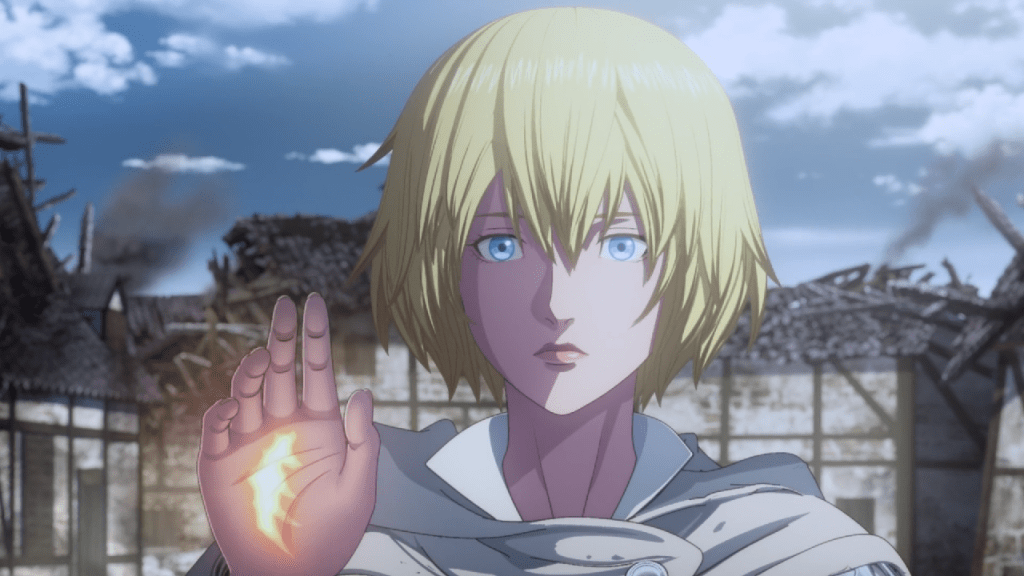
In comparison to the game, I can see where the story team is going with the plot. Not everything is going to be an exact copy story-wise, nor should it. Some things work better in the medium they were created in and need to be redone in order for them to fit into another form. Especially when, in the game, you create your character and go on a quest that’s the same for everyone who plays. With Netflix’s Dragon’s Dogma, you’re now following Ethan, who has his own past and his own path that is very different from the game.
For example, both settings for the game and the show start in a small fishing village named Cassardis. Yet, Ethan is in the forest when the dragon arrives rather than your character in-game being in the village as it happens. This is to coincide with Ethan’s backstory as a hunter in the forest rather than as a fisher, like every other person in Cassardis.
However, both have a key moment, wherein the protagonist picks up the sword and attempts to attack the dragon. This is vital to the Dragon’s Dogma story as it is the sole reason why the dragon chooses to make them (Ethan and your character) an Arisen. However, the reasons for taking up the blade are different between the game’s protagonist, player, and the anime’s protagonist, Ethan.
In the game, your character is doing it to protect your home and its people. This results in the mitigation of greater harm to the village due to your courageous sacrifice. For Ethan, it was an act of wrath, while focusing on the loss of his family and home.
This difference brings me to my next comparison: the naming of episodes for the story’s progression. When I saw that the episodes are named after the seven deadly sins, I was quite perplexed. This is not a concept in the game. I mean, you can attribute some characters to certain sins, but it’s not an overt, overarching theme when it comes to the story. This idea ends up weighing down the show as they try to shoehorn the sins into each episode, mostly unsuccessfully.
In terms of judging the first episode on its own, one thing I noticed immediately was the CGI, which does not bode well when it comes to first impressions. The animations are stiff and often appear to be emotionless, making it difficult to relate to the characters. Meanwhile, the dialogue doesn’t help with this problem either—in fact, it makes it worse. With repeated uses of trite lines, such as “breakfast is the most important meal of the day,” it’s hard to take it seriously.
There were also some awkward moments, such as Ethan and Louis (an orphan Ethan and his wife had taken in as their own) having a conversation with some guards while walking past them at a considerable distance.
Overall, I give this episode a 4/10. In terms of story, it wasn’t terrible but it wasn’t special either. Also, at this point, the CGI and stale dialogue had me quite dubious of what was to come.
Boy, was I right…
Episode Two: Gluttony
This is where Netflix’s Dragon’s Dogma strays far from the game in terms of geography and story. In the game, there are only 2 towns: Cassardis and Gran Soren.
I know, I know, it sounds ridiculous to have only 2 towns in a fantasy game, but a lot was cut out of the game during production due to budget constraints. So, I understand adding more villages for the show to make it more interesting. However, in terms of the Pawn, Hannah, they do stray quite a bit compared to the source material. This change is less understandable.
Her vocation, or what you might call “class” are significantly changed between the anime and game. There are nine vocations in the Dragon’s Dogma: Dark Arisen game, starting with the base classes of Fighter (sword and shield), Strider (dagger and bows), and Mage (staff). Then you have the upgraded versions of those vocations with the Warrior, Ranger, and Sorcerer. Next are the mixed classes, such as Assassin or Mystic Knight. Hannah is very obviously a Magick Archer, she uses a bow and magick (as it is spelled in the game). This is an issue conflicting with source materials because Pawns can’t be any of the mixed classes, only the Arisen have this option.
Not to mention the writers decided to make her detached in a way that is heartless and inconsiderate. While Pawns in the game lack a true will of their own, they simply follow the Arisen wherever they go and are always trying to help the Arisen regardless of the quest.
Anime-Hannah, on the other hand, doesn’t care to help anyone and only wishes to commit to the quest of finding and slaying the dragon. A stark contrast to Pawns in the game as they give advice on current quests and don’t complain about wasting time.
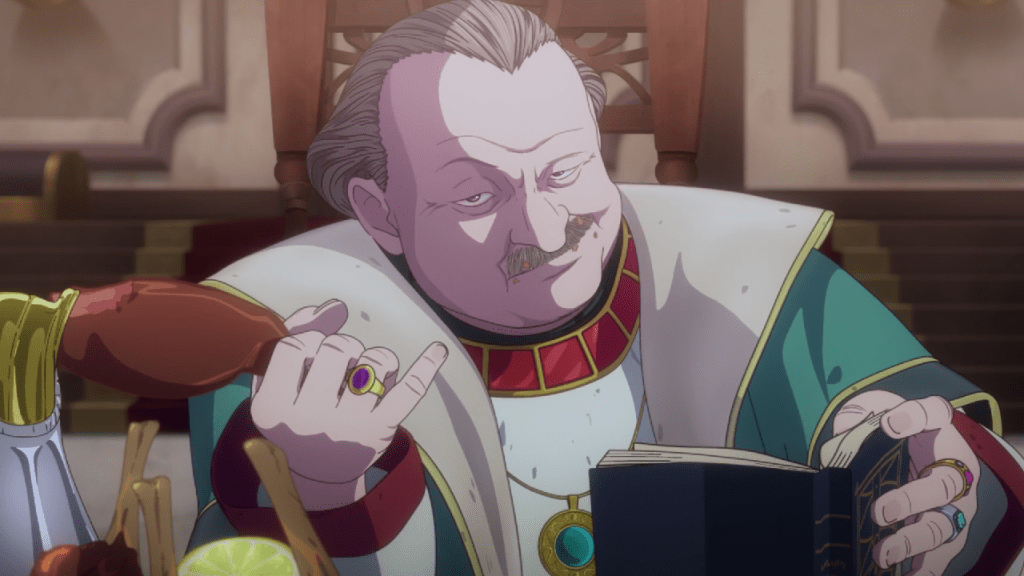
Returning to the episode, my judgment is that it is very bland, with more predictable dialogue and obvious story beats. For example, there is a corrupt mayor who is starving the townspeople and using a Cyclops as a tool to seize all of their belongings and food in order to satiate his gluttony. It was simply a classic case of “Evil, just because.”
The mayor was so comically evil that it even caused an eye roll or two and the “twist” at the end didn’t fare much better. I sighed in disappointment as the townspeople became the embodiment of gluttony. This episode is a taste of the template that the show follows throughout the rest of the season:
Something bad is happening → Main characters help → Someone or something represents the sin the episode is named after → “twist” → character(s) for the episode die or is/are afflicted → the end
There are very slight variations to this format depending on the episode, but this is what it all boils down to, and it becomes redundant almost immediately.
I give “Gluttony” a 3.5/10. It’s definitely worse than “Wrath,” but the narrative structure hadn’t quite hit me yet with how repetitive it’s going to get soon after this.
Episode Three: Envy
Disclaimer: MATURE CONTENT WARNING – This episode review contains content that we at The Anime View do not think is suitable for everyone. Possible triggers or subjects include sexual assault and suicide. By clicking “Read More,” you understand that you may encounter such content. Reader discretion is advised.
Continue reading “[Anime Review] Dragon’s Dogma: Compare And Contrast”
