
By: Peggy Sue Wood | @pswediting
At some point later this year I will likely be presenting on this topic at a local convention, and–as such–I’ve decided to share with you all in this post about the topic at hand. If you would like to view the presentation slides, you can do so by clicking here.
For context, this is something I’ve done on my own for a long time and something that I was, interestingly, assigned to do in one of my Japanese culture classes. It can be a fun activity for those of you at home, as well as an educational one for those of you in school or teaching. For a larger cultural context, due to the pandemic, many tourists faced travel restrictions and were unable to visit their desired destinations around the world in the last couple of years. Japan was among the countries with some of the strictest measures regarding travel, and while Japan’s tourism restrictions were lifted in October 2022, some individuals may still be wary of going abroad at this time. In this post, I will explore how to embark on a virtual tour to one of my favorite places to hear about in Japan by using anime as the inspiration and Google Maps for visual aids. The idea is that those reading this post and those that will eventually view the presentation/workshop can gain some inspiration and insight for how to become a virtual tourist in addition to enhancing your virtual journey with research techniques to add to your cultural knowledge. In this post and in my presentation, I will be using Detective Conan, also called Case Closed, to demonstrate how one might virtually tour another part of the world. With that, let’s begin!
Geography is used all over in anime to help create realistic settings. In Ranma ½, for example, with the character of Ryoga Hibiki, we get to see different parts of Japan as he gets lost. Other works like Code Geass, which explores primarily a fictionalized Tokyo, and Zombieland Saga, which looks at the Saga prefecture, we can see how important location is in anime and manga overall. The setting not only acts as a backdrop but can help situate the story in our minds, creating a sense of “familiarity and ambiguity” talked about in cultural reviews of this particular media (“Japan cracking US pop culture hegemony”).
Part of that familiarity, I believe, is the real-life settings we see both in and outside of Japan from the media. This idea of taking real-world places and fictionalizing them for the story’s setting is pretty typical of comic and animated works internationally. For example, if you look at popular American works, the setting is almost always fictional pseudo-cities, like Gotham for Batman or Metropolis for Superman. However, these fictional cities are inspired by real-world places: as a prime example, Gotham and Metropolis take inspiration from New York City.
For works coming out of Japan, I think that a significant amount of anime and manga have their fictional stories take place in real-life settings like Tokyo, Osaka, Kyoto, and more–even narrowing further into specific streets and alleys that the creators—and, probably, members of the population consuming these works—are going to have an easy time seeing or flagging in their minds (like a, “Hey! I know that place” feeling).
I think that, rather than breaking the fourth wall, as one might assume, it actually lends to the suspension of disbelief. For example, imagine a modern-day samurai fight scene at Shibuya Crossing—it wouldn’t happen, but you can sort of picture it while looking at the busy crossroads. This can allow a sort of daydream effect where imagination can meet reality without diverging into a total fantasy. I think that it can feed into the suspension of disbelief because growing up I often daydreamed about my reality taking on a bit of magic (such as imagining that the sidewalk was an icy path, which I could ice skate on). Even as an adult, I tend to daydream a bit while doing housework and the like, which seems to be somewhat common.
It can be fun to look at these pseudo-cities and see the magic of it all, but it can be just as fun to find their real-world equivalent and to investigate such places while thinking about making a trip there someday. As one who likes to travel but really can’t do so at the moment because of current responsibilities and monetary reasons, I find it fun to take a look at these places in anime and manga and to search out whether they are real or fake, and, if fake, what the real-world inspiration might have been. This form of virtual tourism, the simulation of destinations through the use of videos, still images, or VR, is still developing as we speak and seems to be beneficial for those limited to travel, as well as beneficial for the companies and places creating such spaces. With that said, let’s begin:
Why Virtual Tourism? There are many reasons why someone may or may not be ready and willing to travel. Travel restrictions, health and safety concerns, costs, and so much more can all be valid reasons as to why one may not be up to physically traveling at the moment, but it has never been easier than now to virtually travel the world and today we’re going to explore how you can do so from home, your phone, or really anywhere. All you need is a device capable of Internet access, some interest, and some time.
I’ve found this form of activity to be great when looking for something to do for a few hours, and it can be fun to share the culmination of your efforts with your friends and family later on.
Today, as mentioned, I’ll be using the anime Detective Conan for my inspirational base. “Case Closed, also known as Detective Conan, is a Japanese detective manga series written and illustrated by Gosho Aoyama. It has been serialized in Weekly Shōnen Sunday since January 1994,” and continues to publish today (Case Closed Wikipedia page). While it is typically set in the metropolitan area of Japan’s capital, Tokyo, the series does travel around to different parts of Japan such as Yokohama and Kyoto. In a few episodes, the main cast of characters visit Osaka, wherein a recurring character Heiji Hattori lives. As a cultural note, Heiji Hattori carries the Kansai-ben (Kansai dialect) accent typical of the Osaka area, and it is this kind of cultural tidbit that I often use as a jumping-off point to learn something I may not have known before about the area.

For example, from learning about the Kansai-ben accent, I ended up in a rabbit hole of YouTube videos regarding different pronunciations of Japanese words for the different dialects. It ended up making me laugh because my dad, who is fluent in Japanese, has an Osaka accent from his time living in Osaka while my Japanese instructors tend to have the standard Kanto accent. I still have trouble identifying the difference, but my instructors have told me on several occasions that they find my pronunciation of various words to be more like an Osaka/Kansei-ben accent than a Kanto/Tokyo one, likely because I practice Japanese with my dad more than I do in class.
Doing this sort of outside research and building up random cultural knowledge can be some of the most fun aspects of virtual tourism because it is the kind of tangent you might have when traveling abroad as you explore different parts of the area and learn about the people living there. For example, I have been to England and Germany. In both places, I took tours, talked with locals, and learned various small notes that people of the area identified as uniquely theirs or as an important thing for tourists to know.
That said, Osaka is an important place to the Detective Conan anime. For example, the studio that has aired Detective Conan, Yomiuri Telecasting (YTV), has been located in Osaka for several years and has statues of the characters outside their offices (screenshot taken from the street view on Google Earth below). Osaka also hosts the Detective Conan Cafe in the Osaka Station City, which is a business park or shopping center by an Osaka train station (according to my understanding of Google Earth’s description).

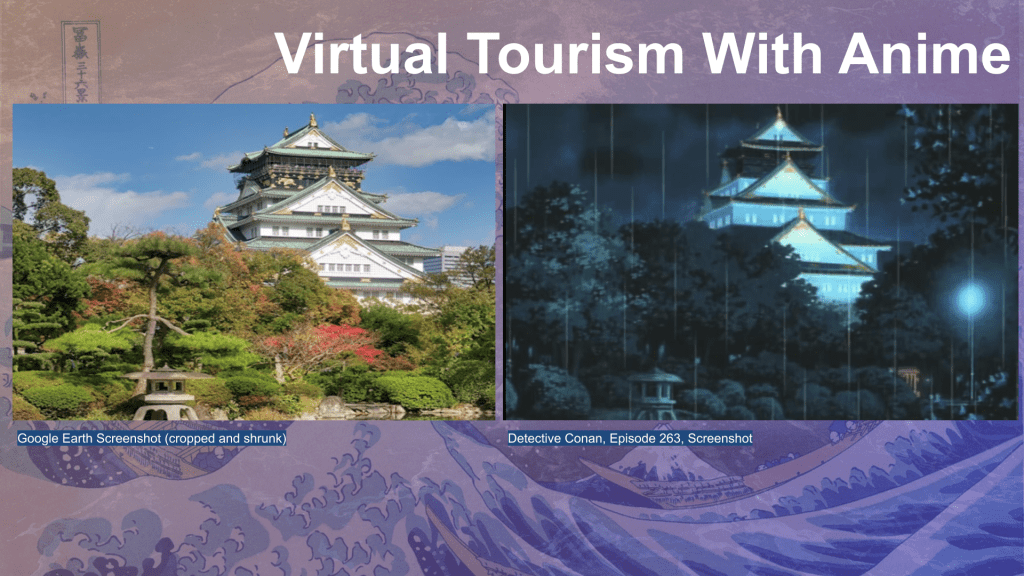
In Episode 263 (Season 10, Episode 5), “The Osaka Double Mystery: The Naniwa Swordsman and Toyotomi’s Castle,” the cast visits Osaka Castle (the Toyotomi Castle mentioned in the episode title). Osaka Castle is a famous landmark of the area, located in the Chuo Ward of Osaka, and the city is located on the island of Honshu (about 2.5 hours from Tokyo by train). What is wonderful about this particular castle in Japan is that you can go on a virtual tour of the building and surrounding area here: https://ivrpa.org/panorama/osaka-castle/
Of course, this is not the only place you can visit using such means as more and more places are digitizing their locations. For example, fans of anime and manga likely already have several wishlist locations to explore like Akihabara, Sekigahara, Kyoto, and/or Naga: all are famous places. You can find various places to visit in the digital space using Google Maps and by checking out websites. Cafes, for instance, regularly feature images, their locations, and menus. You can create an at-home experience for a cafe visit by attempting to make some of the menu’s dishes using online recipes or by purchasing a dessert (like cheesecake) to enjoy while learning more about the cafe or watching a YouTube review of the area.
Outside of big cities, you can go a step further and look at even the smallest of towns and areas, like Hitoyoshi City from Natsume Yuujinchou, which is a real place that proudly shares their locations, architecture, and folklore within the Natsume Yuujinchou work and in the real-world place.
You can also do this for large-scale events. For example, I tend to follow the Japan Cherry Blossom Festival online throughout the month of March and into April using pictures people post online, YouTube videos, and digital advertisements for local viewings.
As mentioned, it really has never been easier than now to perform this sort of virtual tour in Japan and other locations. It will likely get even easier as we continue to progress in this digital age. You can also support the places you e-visit via small donations or purchases.
With that, I will close my discussion on the topic of creating a virtual tour here. I hope you all will give it a try for yourself!
–
If you enjoyed this post, please consider buying us a coffee, leaving a comment, and/or subscribing to us below!
Copyedited by: Katherine Cañeba | @kcserinlee
Discover more from The Anime View
Subscribe to get the latest posts sent to your email.

Yeah, one of the things I love about anime is the little tidbits of cultural information that’s peppered into the fun adventure! Not only is there passive cultural learning, but there is also anime that actually focus on an aspect of Japanese culture. Like, there is anime about rakugo and kabuki!
LikeLiked by 2 people