

By: Peggy Sue Wood | @pswediting
I finally got around to watching MIERUKO-CHAN on Crunchyroll and I couldn’t help but notice two very clear literary references. I was surprised by the lack of discussion surrounding them. Negligence, I say! Pity! Therefore, let’s get into it ourselves:

Firstly, intertextuality is a somewhat broad term referring to how one text references another through either quoting or alluding to another text. Sort of like an idiom, wherein a group of words hold an established meaning that is referential to something else. If I say “slow and steady wins the race,” you may recognize that it comes from the story about a tortoise racing a rabbit.
In literature, the quoting or alluding to another text often is used as a way of making connections between different works to imply deeper meaning. For example, Twilight‘s Bella Swan references reading Jane Austen’s work, implying she’s a romantic. Sometimes epigraphs are also added to a work to let the reader know what the major theme or intent of the work they are about to read is.
Sometimes, it’s subtle nods with hidden references to past narratives, enriching the tapestry of creative expression. Other times, it’s unmistakable moments meant to grab your attention and prompt immediate reflection within the story. Essentially, it’s the ongoing dialogue between texts that enables readers and viewers to draw connections and uncover deeper meanings. With that clear, let’s look at those literary references in MIERUKO-CHAN!
The first reference happens in Episode 1 when Mieruko’s teacher prompts the class to think about the author’s intent behind the story of a man transforming into a tiger. The dialogue raises questions about the loss of humanity and the transformative experience of becoming an animal (NOTE: some variation depending on translation): “What do you think is the author’s intent? Imagine if you turned into a tiger. What is it like to have part of your humanity stripped away?” (MIERUKO-CHAN, Episode 1)
Setting aside the context for a moment, I tried to find this story for a while in preparing for this post. I scoured various sources, including translations of the teacher’s blackboard text and inquiries within my small internet community, yet found no trace of the referenced tale. This leads me to believe that it might be a fictional reference unique to the anime. This idea was further solidified upon examining the manga adaptation, which lacked any mention of the story involving a man becoming a tiger.
However, it’s worth noting that just because I couldn’t find the exact origin doesn’t mean it doesn’t exist. In fact, it could very well be a popular story, especially considering its inclusion in a high school class within the anime. It’s plausible that the story is well-known within Japanese culture but hasn’t been widely translated or discussed outside of it. My lack of familiarity with Japanese high school curriculums further complicates the matter, highlighting the potential for cultural differences in storytelling and education. Evidence supporting this idea might be found on the blackboard in the episode, where there is a reference to the Kanbun Kundoku style used in the story under discussion in class. “Kanbun kundoku is a method of converting Classical Chinese text into Japanese by reordering the words and mapping equivalent Japanese words to the Chinese ones” (Ko Inagaki).
Still, let’s imagine it is a made up reference specifically for the anime. The teacher asks the class—and thereby the audience—to question the meaning behind authorial choice.
What could the creator’s intent be? If you were put in the place of the protagonist, what would it be like to have a part of your humanity stripped away?
These questions, prominently featured in Episode 1, suggest deliberate thought and intentionality from the creator regarding the narrative pattern. This isn’t merely a story about a girl fearlessly navigating through a horror-filled scenario with unwavering composure. Instead, it appears to be a narrative where Mieruko’s humanity, specifically her ability to interact and function normally in the world, gradually erodes over time like the man who becomes a tiger. This, indeed, seems to be the unfolding premise as the series continues and audiences watch Mieruko become more entrenched with the supernatural realm while the semblance of her regular life begins to fade away.
Upon analysis, it seems that making such an outright call to consider authorial intent here and to consider the story being analyzed is meant for viewers to grasp this concept or theme from the very first episode. This is a story where we’re (the audience) meant to question and imagine the depths of such a transformation and the psychological horror of having one’s humanity stripped away as a result.
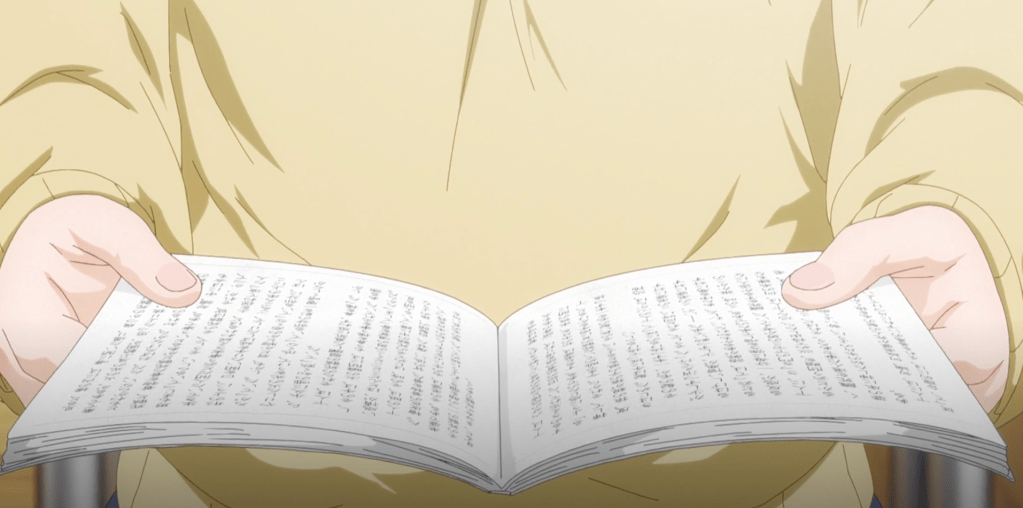
Episode 10 of MIERUKO-CHAN again features the main character and company in class and, again, they’re reviewing literature. However, this time we have a specific story reference that overlaps in the manga, specifically Vol. 3 ch 19.
In both the manga, Vol. 3 ch 19, and anime, Episode 10, the class is reading “Rashōmon” by Ryūnosuke Akutagawa and here is where I went “OH WAIT, doesn’t Ryūnosuke Akutagawa appear in Bungo Stray Dogs? And isn’t there a character that turn into a TIGER?!” However, it is not Ryūnosuke Akutagawa that turns into a tiger, that’s Atsushi Nakajima, and though Ryūnosuke Akutagawa wrote “Tiger Stories” there does not seem to be a story of a man turning into a tiger by Ryūnosuke Akutagawa… so, this became a useless tangent.
(EDIT 10/27/2024: @dendria21 on WordPress commented that the story I was looking for that matches here is from “Beast Beneath the Moonlight” by author Atsushi Nakajima where a man turns into a tiger. I’ll have to do a follow up post on this later!)
Back to the point then.
In both the manga and anime, the class is reading “Rashōmon” by Ryūnosuke Akutagawa, which you can read for yourself here: https://shortstoryproject.com/stories/rashomon/. While it’s a recognizable reference for those who attended Japanese high schools, it is a reference that Western audience members like myself might not grasp the significance of when first watching.
This short story is, apparently, often studied while focusing on themes of death, moral ambiguity, human frailty, and the complexity of human nature in challenging times. Questions like, “What is righteousness? What is evil? How are we to decide?,” seems like the kind of questions reading this sort of story would prompt as readers are meant to consider the idea of subjective truth, suggesting that reality is often shaped by individual perspectives and biases. I think that this fits Mieruko’s story very well, because by Episode 12 Mieruko is challenged with identifying good from bad through visuals alone and, like we see with the main character of “Rashōmon,” it’s hard to judge with opinions changing overtime between good and evil and uncertainty.
The end of “Rashōmon,” in the English translation, reads as follows, “Beyond this was only darkness… unknowing and unknown” which describes what a character sees when looking out into the streets. This is sort of where Mieruko’s story ends off in Season 1 as the audience and Mieruko herself are left in darkness, looking out into the unknown with unknowing eyes.
Therefore, if we look at Mieruko comparatively with the intertextuality elements, the series takes on a deeper psychological horror from it’s slice-of-life, comedy approach to a girl seeing spirits. The literature and the anime/manga become a more interesting exploration of fear and the unknown. Showcasing the creators’ ability to blend horror and comedy in a way that makes, for example, the narrative twists—like the shrine not being a place humans should be able to find despite her GPS leading her there initially— all the more unexpected and frightening.
As the series continues to unfold, I look forward to seeing what else the creators will throw in regarding literary references. This time it lead me to “Rashōmon,” next time—who knows?
Well, thanks for reading! & Happy Halloween this 31st ~
Developmental edits by: Krow Smith | @coffeewithkrow
Discover more from The Anime View
Subscribe to get the latest posts sent to your email.

Beast Beneath the Moonlight – Nakajima Atsushi
LikeLike
THANK YOU! I’ll need to read this a do a follow-up!
LikeLike