
By: Peggy Sue Wood | @pswediting
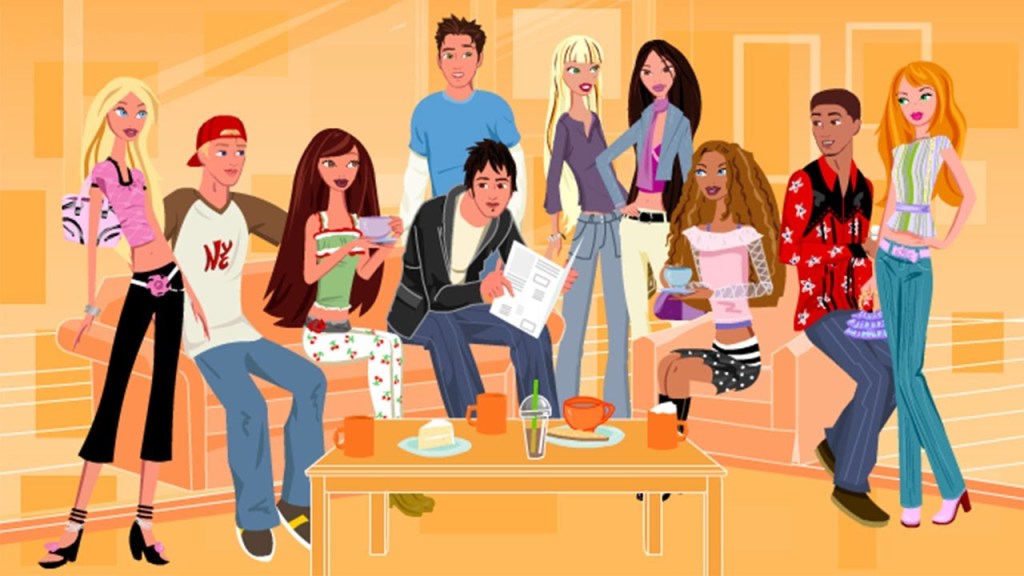
I was looking for something nostalgic to watch on YouTube when I came across a compilation of all the MyScene webisodes from 2000 to 2006. In my memory, MyScene was a goofy-looking web series about a group of fashionable late-teen girls (an Alternate Universe version of Barbie, Madison, Chelsea, Nolee, and Delancey) living it up in the Big Apple (New York City). Like many other animated shows at the time that featured girls of a similar age, particularly with a girl-focused demographic, it seemed like a series meant to extend the brand’s world and show off the best friends navigating crushes, fashion, and friendship in an urban setting. Very par for the course, if you will.
It wasn’t something I really focused on as a child because the show itself always felt secondary to the games. MyScene was Mattel’s attempt to compete with Bratz in a way the traditional Barbie never quite could. However, the dolls were not really in my sights at the stores as I was pretty obsessed with Polly Pockets at the time.
So, in finding the show on my random 2 AM search for something nostalgic, I was like, “sure. Let’s watch it.” However, while I was watching the show with more focus, something clicked for me—why MyScene never fully grabbed me back then, even though it should have considering I was in the target demographic. Even as a pre-teen, something about MyScene always felt off, though I couldn’t articulate it at the time.
In essence, this series feels like Sex and the City filtered through Mean Girls but was scrubbed clean of sex for the tween audience it is targeting. While there are no burn books or public humiliation campaigns, there’s a steady undercurrent of petty behavior and emotional digs throughout the series. It’s aimed mostly at anyone outside the inner circle, but occasionally at each other whenever someone on the writing team, I assume, thought it’d be funny. I see less genuine friendships from the series and more of a we’re friends because we run in the same financial circle kind of grouping. I mean, these girls are… just mean? No one really apologizes either.
For example, let’s note the way the core three first become friends with Nolee. The series starts with Barbie, Madison, and Chelsea (the core three) before adding Nolee and later Delancey among others. Madison and Barbie meet Nolee in a store where they reach out for a top that Nolee grabs first. It starts with them insulting Nolee’s clothing choice through a backhanded compliment and escalates to buying the top out from under her to give to Chelsea. Later, the group run into her again at a club where Nolee admits that Chelsea looks good in that color and then they all laugh it off. As another example, when introducing Kenzie, a later addition to the cast, she’s initially brushed off entirely by the group. The girls act like miniature Karens until they realize Kenzie is a fan of Chelsea’s flea‑market fashion designs and then she magically matters all of a sudden. There’s also a point where one of them locks a boy in a locker—played for laughs.
In all, they have a general habit of dismissing people until they prove they’re useful, stylish, or socially adjacent enough to be tolerated. The tone is oddly arid as well. Just as the tension peaks and it seems like a fight is about to break out, the show switches to laughing it off as if nothing happened and with a rushed sense of resolution.
The girls are also wildly out of touch. Wealth disparity hangs over everything in a way that never quite existed with the Bratz movies or even Winx Club (which did show some wealth disparity between the girls). Another thing I noticed, too, is that they often turn Madison, the only dark-skinned character in the group, into the person initiating most of the direct insults. However, all of the girls are passively mean or accepting of the same behavior.
There’s rarely a real “lesson learned” moment. It’s more like: Just kidding! We’re best friends! Roll credits before I pull her hair out on camera.
It insists it’s all in good fun but watching it now, it doesn’t feel like a joke. Rather, it feels like a grave misunderstanding of their audience. That right there is a major gripe: the distortion of the teenage girl experience. Sure, it’s fictional, but it’s meant to draw in an audience that can see themselves in the MyScene characters. By framing teenage girls as being vapid and drama-ridden, it’s not so much a mirror or model for the demographic, but moreso a reflection of the writers’ inability to meet their audience where they’re at. It made me realize a lot of the reasons why MyScene as a whole was a commercial flop.
Revisiting MyScene has been an eye-opening experience, especially when I was anticipating something positive and nostalgic. I will still look fondly upon the brand’s online games, but the show isn’t so lucky—for good reason, too.
Do you remember MyScene? How do you feel about it? Let us know in the comments below!
–
If you enjoyed this post, please consider buying us a coffee, leaving a comment, and/or subscribing to us below!
Developmental and line edits by: Krow Smith | @coffeewithkrow
Copyedited by: Katherine Cañeba | @kcserinlee
Discover more from The Anime View
Subscribe to get the latest posts sent to your email.
