
By: Peggy Sue Wood | @pswediting
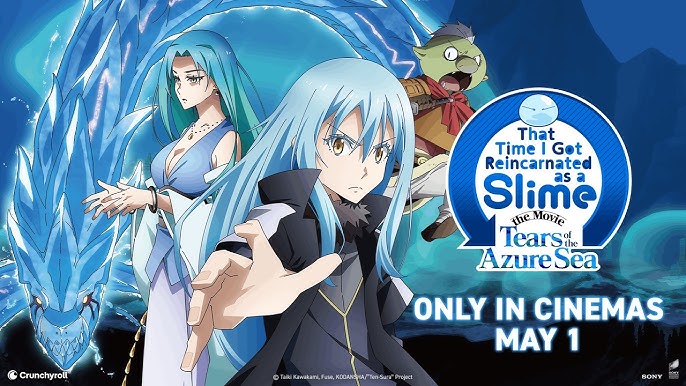
Last week, I went to see That Time I Got Reincarnated as a Slime the Movie: Tears of the Azure Sea (2026) in theaters, and I ended up watching it twice (once dubbed and once subtitled). While I really enjoyed the movie, I think that if you’re on the fence about going to watch it, I’d honestly recommend waiting to stream this one. Compared to Scarlet Bond, Tears of the Azure Sea feels less, uh… realized in comparison. It’s still fun, especially if you’re already invested in Rimuru and the world, but it doesn’t quite land with the same way or with the same depth as Scarlet Bond does. For dedicated fans, it’s probably still worth the watch; for more casual viewers, it may not feel essential to view right now.
If you do plan to see it in theaters, I recommend watching the subtitled version. The difference was noticeable and the sub-version carries the story better from a narrative perspective. The translations, as reading them, make more sense and the emotional weight is much more effectively conveyed as a result. Meanwhile the dub feels uneven in places, with line delivery that can come across as rushed or slightly disconnected between character’s dialogue with each other or from the tone of the scene.
Watching it twice, though, led me to an unexpected reflection as I kept thinking about Atlantis: The Lost Empire (2001). Slight spoilers ahead:
On the surface, the overlap between the two movies is easy to spot. Both films involve a hidden or isolated civilization (though Atlantis makes that its central focus while Tears of the Azure Sea uses it more as a backdrop to the character-driven conflict). Both stories also show political tension, have a twist, and the presence of a female lead whose true power is not fully understood or is deliberately concealed from those around her/herself until close to the end. That, however, is I think were the similarities would end for most people as, stylistically, the two couldn’t be more different.
Atlantis leans into sharper designs and a sense of ancient, almost mythic stillness in its setting. The people of Atlantis a stagnate in many ways and set in a way of life that is so long they’ve forgotten much of what used to be. Meanwhile Tears of the Azure Sea embraces the fluidity and emotional expressiveness of anime. Both towns may appear dark and underwater in bubbles featuring civilization, but Tears of the Azure Sea is advancing. People age, and technology grows, so they’re not the same culturally or visually.
The humor is another point of divergence. Both films rely on character-driven comedy, but Tears of the Azure Sea leans more heavily into rapid tonal shifts and overt humor, while Atlantis keeps its comedy more integrated into the broader narrative.
Yet, still, while watching, I kept noticing echoes between the two movies. So much so that I went home and watched Atlantis after my second viewing of Tears of the Azure Sea. Even though there are not a lot of clear parallels here, pairing this film with Atlantis right afterward made those connections feel more persistent even if I couldn’t figure out what it was I was seeing.
I think that, what made them pair well is a thematic core shared between the two movies.
Seen side by side, the films create a cross-cultural echo, though they ultimately convey very different messages.
I think that Atlantis carries a quiet melancholy, suggesting that preserving culture may come at the cost of progress. Given the context of its early-2000s release, that message can feel somewhat pessimistic. It reflects a broader trend in American media at the time, from what I can recall, as well as in certain sides of media now: a trend to frame the past as safer or even superior, implying that one must choose between tradition and advancement, rather than reconcile the two.
In contrast, Tears of the Azure Sea leans toward integration, emphasizing how new ideas can be incorporated into an existing cultural framework. I think that contemporary Japan in media seems to be more often characterized by this kind of balance between drawing on a long, well-documented history while continuing to evolve through innovation and adoption of new materials.
Viewing both through this idea of cultural reflection towards certain ideas is a topic I did not expect to find watching a movie about a slime and his friends on vacation. Viewing them together adds a sense of depth, making each feel more layered and intentional upon revisiting. It makes me want to do a more thorough review of the ideas presented and to see if that accurately reflects the messages I’ve described above in the context described since I have not done a thorough media analysis on either and was under 10 in the early 2000s so memory is a little hazy…
Anyway–did anyone else get this feeling? Like, about the two works possibly connecting? Or do you think I’m completely off-track here?
If so, please let me know in the comments below!
Discover more from The Anime View
Subscribe to get the latest posts sent to your email.
