
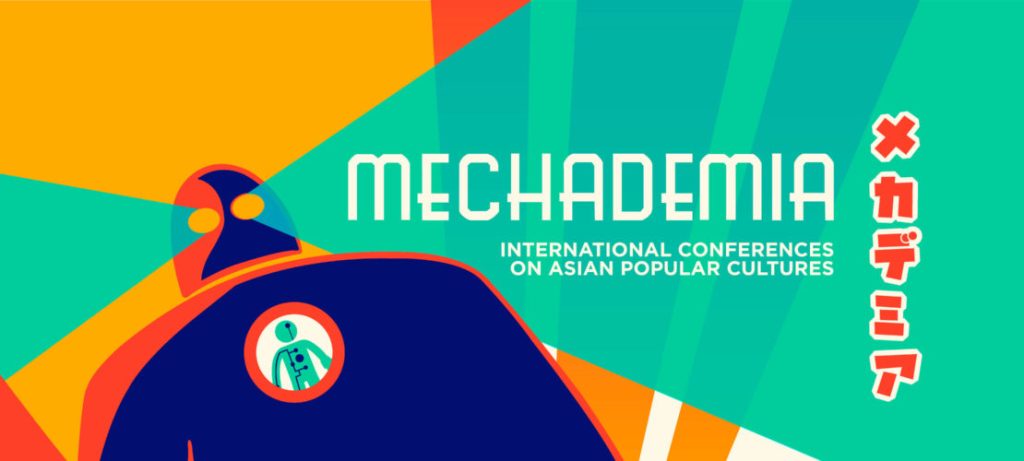
At an Anime Expo some time ago, there was a keynote and subsequent panel from Mechademia presented by Frenchy Lunning, founder of Mechademia and longtime scholar of anime and manga studies. Here are some (belated) notes from that session discussing Mechademia.
What is Mechademia?
The answer: a conference, a journal, and academic community that is ever expanding!
Mechademia began as an effort to create academic space for manga, anime, and related media at a time when these topics still struggled for legitimacy within universities in the West.
Today it has grown into a network that includes:
- Conferences in the United States and Asia
- A completed ten-volume anthology series titled Mechademia
- An ongoing biannual journal, Mechademia: Second Arc
The organization brings together scholars, creators, professionals, and fans studying not only manga and anime, but also:
- Gaming
- Performance
- Transmedia works
- Global fan practices
- Emerging visual cultures shaped by anime and manga aesthetics
The keynote repeatedly emphasized something that stood out: The people involved are both fans and academics. That alliance between fandom and scholars became one of Mechademia’s defining identities.
How It Started
In 2001, after becoming an anime fan herself, following a viewing of Akira, Frenchy Lunning was teaching at the Minneapolis College of Art and Design and students kept asking for anime classes.
Instead of immediately creating a course, she organized a weekend workshop and contacted seven scholars, hoping perhaps one person would agree to participate. All seven accepted and the workshop had been planned for September 14, 2001.
For those of you outside of the US, three days prior to the workshop, the September 11 attacks occurred. Travel was halted as flights stopped and many were scared for the future. The event was postponed and eventually held months later in November 2001 under the title: Schoolgirls and Mobilesuits (SGMS)
That workshop became the foundation of what would later evolve into Mechademia. The original participants included scholars, artists, writers, editors, and industry professionals—already signaling the interdisciplinary direction the organization would take.
Presently
Mechademia emerged at a time when anime and manga scholarship remained relatively marginal in many academic spaces. It still is, but since then the field has expanded significantly. Anime and manga studies now contribute to conversations around:
- Literature
- Cultural studies
- Media studies
- Performance studies
- Pop culture studies
- Fan studies
- Globalization and transnational media
The keynote argued that communities like Mechademia helped break barriers:
- Within universities
- Between scholars and industries
- Between academia and fandom
At the same time, fandom itself continued growing into communities of thousands—perhaps millions. The academic conversation grew alongside it.
For example, just last week (21-24 May 2026) Momo-Con held its second academic conference in the Atlanta, GA. This kind of scholarship and symposium growth can be directly tied to the success of prior conventions like those Mechademia began in the early 2000s and which JAMS has been continuing in recent years.
So You Want to Study Anime Academically?
Well, you can (and should) probably check out my slide deck on the topic, view here: https://docs.google.com/presentation/d/1aFQoYCAo_Wef-wCgsSmvrgXpJh9oQ9Jd/edit?usp=sharing&ouid=108757933484591052415&rtpof=true&sd=true
Expanding on that, one element that Lunning reiterated several times:
Find the right people–research communities matter, mentors matter, and networking matters.
The advice was not simply “publish more,” but rather that all those interested find scholars whose interests align with your own.
Ask:
- What do I want to study?
- Who is already doing related work?
- Where does my research fit?
Another note from the panel captured this idea well: “See your work.” In other words: understand how your project enters an existing conversation in the academic discourse.
What Counts as Academic Publishing?
The session also demystified publishing for newer scholars. Academic work in anime and manga studies can include:
- Journal articles
- Book chapters
- Conference presentations
- Edited collections
- Short-form cultural essays
Conference papers often run approximately 5,000–10,000 words, roughly equivalent to a two-hour presentation, but publication is not just about writing. The panel repeatedly stressed that, before looking to publish, you must read the journal before submitting to it. Understand what is:
- Its audience
- Its methodology
- Its conversations
- Its priorities
The question is not merely:
What is my article saying?
Rather:
What larger conversation is it joining?
Journals and Publication Spaces
Several publication venues and research spaces were mentioned during the discussion, including:
- International Journal of Comic Art
- The Journal of Graphic Novels and Comics
- The Electronic Journal of Contemporary Japanese Studies
- Journal of Anime and Manga Studies
Topics ranged widely:
- Manga history
- Word-and-image studies
- Material culture and everyday objects
- Pop culture studies
- Media industries
Current Research Trends
The panel also highlighted emerging and continuing areas of interest within anime and manga scholarship:
Queer studies
Ecocriticism / environmental studies
Media mix research
Transglobalism and transnational circulation
Film and media studies intersections
Anime studies has increasingly expanded beyond textual analysis into broader questions of circulation, fandom, labor, identity, and globalization.
Methodology: How Do You Study Fandom?
The final session notes touched on research methods for anime and fan studies.
Methodologies discussed included:
- Fandom studies
- Focus groups
- Interviews
- Textual analysis
The panel referenced work, Doing Academic Research: A Practical Guide to Research Methods and Analysis (Second Edition) by Ted Gournelos, Gary Beck, and Timothy Hackman.
Conclusions
What stayed with me most from the keynote which I have carried with me ever since is that becoming an academic is not just about publication or research. Academia is much more expansive than that, even if that is a general mindset among peers.
Mechademia exists because people who loved anime decided that love itself was worth studying. Scholars became fans and fans became scholars, and somewhere between convention halls, journals, classrooms, and conference rooms, anime studies built a community.
For a field that once was fighting simply to be taken seriously, it is now finding its place all over as the interdisciplinary field finds roots in various places and grows its own. To me, that may be its greatest accomplishment as a journal and something I hope we can all continue working towards!
Discover more from The Anime View
Subscribe to get the latest posts sent to your email.
