

By: Peggy Sue Wood | @pswediting
So, in 2023 and 2024 I went on what I would call a “Convention Crusade.” I went to several conventions, presented a lot, and basically went way over-budget when it came to purchasing. (It did not help that my credit limit went up right along with it!)
Now—thankfully—I have some self-control and didn’t max out any cards or leave myself in an unrecoverable position, but I did need to slow down.
While recovering from the crusade, I realized that I had accumulated at mass amount of merch that I didn’t need which was stacking on a lot of older stuff I’ve been avoiding getting rid of because I hate packaging and shipping.
Still, I readied myself to do some re-selling beyond my loathing of the packaging and shipping because I needed some money back and it was time. My plan was to hop on eBay and start slowly offloading, but a friend of mine recommended I try Mercari.com instead because its where a lot more anime-fans tend to shop.
So, I decided to give it a try and after spending some time selling on the platform, here’s a breakdown of what it is, how it works, and the highs and lows from a seller’s perspective for any fellow anime-fan who might be looking at their shelves right now and realizing you’ve somehow accumulated way more merch than you can reasonably justify keeping when storage prices are as high as they are.
What is Mercari?
If, like me, you’re a little out of the loop, Mercari (https://www.mercari.com/) is a mobile-first (often second-hand) marketplace where people can buy and sell pretty much anything. It is a lot like eBay; you can find clothes, electronics, collectibles, and plenty of anime merch for sale there (think figures, manga bundles, keychains, acrylic stands, and convention pickups). It does not have everything, but it is a much bigger platform then I thought it was when first checking it out.
Listing something is pretty straightforward. You upload photos, write a description, set a price, and choose your shipping method. Mercari even suggests pricing based on similarly titled items, which can be helpful if you’re not sure what something is worth, and you can set it to auto-lower the price if its not selling so that it lowers the price incrementally over the proceeding days.
Once an item sells, you package it and take it to the post, where you can use their QR code system allowing the label to be print and paste on to the package at drop off. You are supposed to ship in a required time window, which can be a bit of a problem if you are in an area where the post office tends to have shorter hours, but generally its a pretty good system and the few times I’ve been late to ship, it was easy to notify buyers as to why and still get the code scanned and item sent.
Once the buyer receives it and rates the transaction (or three days pass), you get paid.
That last step is important to note though because you don’t get paid until the buyer confirms everything is acceptable or time has passed. It adds a layer of protection, but also means you’re waiting a bit.
The Good
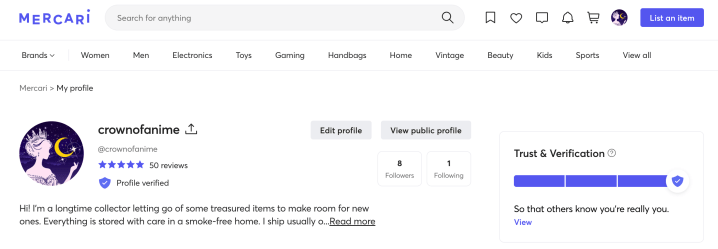
One of the things I liked most about Mercari is the built-in verification system. Before listing I had to provide three verifications (email, phone, and government ID) (seen top right of image above, you can see the dashboard shows when you’ve completed verification steps). The last one really threw me for a loop because I’ve never had to do that with online selling before. However, it also gave me some good insights because it means anyone I’m buying from has been, to some level, verified as a real person selling. Moreover, between user ratings, transaction history, and identity confirmations, there’s a decent framework for building trust between buyers and sellers here.
The other things I really like is that the app is genuinely easy to navigate. Listing takes minutes from your phone or computer, and the shipping process is streamlined enough that you don’t feel like you’re drowning in logistics. One of my biggest complaints with eBay years ago, and other second hand selling apps like Poshmark, was often the requirement to print a label. I don’t have access to a printer at home, which means it has to happen at work and, frankly, I don’t like printing personal stuff at work. It feels icky.
For someone like me who just wants to offload some extra merch without turning it into a full-time side hustle, that simplicity is a big win.
Then there’s the already strong market for anime goods. You don’t have to go hunting for buyers because they’re there browsing and Mercari is forwarding new items based on their search history (which you can experience first hand while logging in and seeing the front page). If your pricing is fair and your photos are clear, things can move faster than you’d expect.
The Bad
One thing I dislike about the app is the notifications. I feel inundated with notifications as they constantly alert to my phone and it does bother me. Sometimes it is important (like making a sale) and sometimes its just “check out what’s new!”. That got old very quickly for me, even if the sale alert is different from other notifications.
One of the other more annoying quirks is that even if you remove a listing, Mercari keeps a record of it as a listed item. For example, if you listed an item but then sold it to a friend locally (I did this regularly to avoid shipping and fees for friends), that listing still lingers in your history, which I don’t love as it gives me an inaccurate account of sales through the app.
I also don’t like the three day shipping range. I hate to say this, as I’ve heard from others that the three day wait for getting paid is already a bother, but I think 4 days would be better (and that includes for the buy ratings too).
What sells kind of depends. I’ve had good luck with key chains and books, but that’s not always the case. Plushies—even MINT with tags—are not big sellers unless you have specialty items. For example, I had Monster High Plush Dolls that sold super quickly at the beginning, but anime plushies that ended up selling to friends instead. Books too will have far better luck on eBay.
All that said…
If you’re an anime fan looking to casually sell figures, manga, or extra merch, Mercari is a solid option. It’s accessible, relatively safe, and doesn’t require a ton of effort to get started but it’s not perfect.
I’ve had a pretty luck so far. In the 6 or so months I was using the platform consistently (about June to December 2025), I made $578.19 in sales. Deducting the fees, Mercari says I’ve made $492.72, and minus cost of shipping materials/other expenses, I’d say the number is closer to $415 in actual income.
That’s not bad for a side-listing of random items and not including sales I made to friends after sending them my store page so that they could tell me what they want from my stock and sell off-web.
It’s definitely a useful tool especially, when your collection starts outgrowing your shelf space, and it can also be a nice website to buy some merch from as well. As a user, I’ve certainly bought a few pins and bags that caught my attention since finding the website!
It definitely feels a little like anime-ebay to me and I’m a-okay with that!
So, if you’re looking to sell some of your items, maybe check it out!
Discover more from The Anime View
Subscribe to get the latest posts sent to your email.
