
By: Peggy Sue Wood | @pswediting
Earlier this year, I wrote about Anime Town Greenville’s January convention, which was severely impacted by the snowy weather. Despite the circumstances, it was actually one of the best convention experiences I’ve had as a regular attendee since Anime Town Greenville began a few years ago. I was heartbroken to see the weather keep so many attendees away, ultimately devastating what I believe should have been the convention’s biggest and most successful year yet.
At the time (end of January/early February), I held off on publishing my review. A vendor friend of mine (shoutout to Let’s Say Gay!) mentioned hearing whispers from convention planners that Anime Town might return to Greenville before the end of the year. I wanted to give the convention a little time to make that announcement before publishing my thoughts, particularly since I didn’t want to post a review for an event whose chapter wasn’t fully closed.
By May, I still hadn’t heard anything concrete, so I finally dusted off my draft and published it. I stated then that I was hopeful we’d see it return in 2027 with what had worked in early 2026.
Then, in June, shortly after my review went live, I heard from my friend that an official announcement arrived for them.
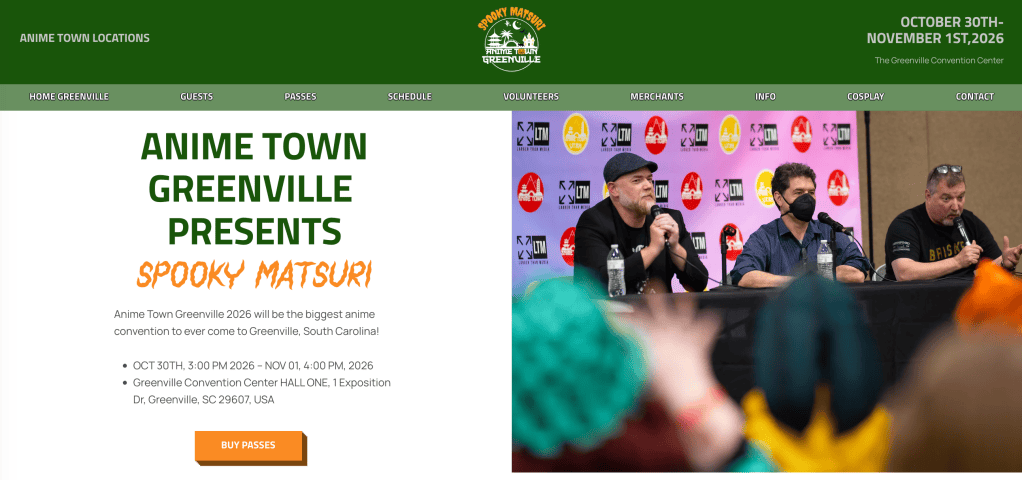
Anime Town Greenville was coming back in October. On Halloween weekend, no less!
I was excited, but admittedly skeptical. Running a convention is an expensive undertaking. Between venue rentals, staffing, guest appearances, vendor arrangements, and all the other expenses that go into putting on an event, there is a lot of money involved before the doors even open. Not to mention time to prep, plan, and promote. Knowing how poorly many vendors had done financially at the January event, I wasn’t entirely convinced that Anime Town would be able to recover enough to deliver the same energy and improvements we’d seen earlier in the year. Unfortunately, those concerns weren’t entirely unfounded.
This was probably the smallest Anime Town Greenville I’ve attended, which is saying something considering that the organizers typically rent a fairly sizable venue. The panel room (no longer multiples) had returned to a somewhat enclosed space, separated from the larger vendor area by curtains rather than actual rooms. The convention hall itself was similarly sectioned off, with curtains dividing the event space from the otherwise open areas of the convention hall. While there were some positives, such as the cafeteria being well staffed, the bathrooms clean, and the different areas reasonably organized, there was one major problem: the convention itself felt remarkably empty. I’m not a videographer, and I don’t have official attendance numbers, but from what I could see, attendance seemed considerably lower than I’ve seen at pretty much any convention I’ve ever been to, and since I’ve been to about 11 this year, that made it pretty noticeable to me.
The vendor floor was particularly telling. Empty tables were scattered throughout the hall on Day 1, and some creators eventually began spreading out to fill the gaps around them. By the second day, one vendor had moved into an entirely different row and taken up two additional tables to fill space. Other sections were repurposed into extra seating areas for attendees who wanted somewhere to eat or rest, which did cover up a good amount of how many vendors were just missing. I mean, even Chalk Twins, whose live drawing demonstrations I’ve enjoyed at several conventions since beginning my convention tour of South Carolina, were absent. Their blanket vendor and dragon photography area remained, but the live drawing experience I’d come to associate with them was missing.
As the with the artist alley area, the trading card game section grew to incorporate more tables, and my friends’ vendor setup expanded as much as they could manage to similarly cover blank space for the illusion of growth. It seemed as though everyone was trying to make the available space feel a little fuller and give attendees more to see and do. Unfortunately, there is only so much vendors can do to make up for missing attendance.
One of my biggest concerns came toward the end of the first day regarding sales for the various vendors. I had made a fairly substantial purchase (for me) at one vendor’s table, spending somewhere between $50-$100. As I was finishing up, the vendor mentioned that I had made their biggest sale of the entire day. This was nearly 30 minutes before closing and that really put things into perspective.
At the table I was working, which is my friend’s table (in exchange for a ticket to the event), we don’t make money. Her’s is a non-profit donation based charity so I wasn’t really tracking what was coming in at the event. However, it is something I try to consider with others. Checking at random with a few others at various areas in the convention hall, it appeared that many had not been making good sales. Several vocalized that they did not feel they would break even and, for creators, that is a big deal when the cost of tables, travel, and such are so high.
I had spent the morning, roughly 9:30 AM to 1 PM on Day 2, helping my friends at their vendor table. Afterward, I spent another two to three hours walking around, making purchases, and enjoying what the convention had to offer. By around 3 or 4 PM, I decided to head home and rest as I felt myself becoming exhausted. On November 1, the third and final day of the convention, I had come down with a slight illness that prevented me from attending. However, according to my friends still participating at the convention, the event’s already low energy had pretty much died. They had one of the more active table areas, because of a scavenger hunt for cuccos (the chickens from the Legend of Zelda series) that they hosted (earn a ribbon by finding all eight in the vendor hall), which kept some people engaged. However, on the final day, given little attendance and very few stops by attendees at the table, my friends told me they decided to pack up early and head home.
With all that said, what can we learn from this?
Where Does Anime Town Greenville Go From Here? (If it comes back)
For anyone unfamiliar with Anime Town, the convention is relatively small compared to some of the larger anime conventions in the country. However, the organization itself operates events across several parts of the United States, particularly Florida and other Southern states. They also have a reputation for bringing in some recognizable voice actors and guests.
If you’ve heard anything about this particular October event, you may have encountered some of the conversations surrounding its costume contest, which left some attendees concerned about cosplayers (something I will not get into here), but—overall—nothing egregiously bad about them from an attendee perspective.
The venue is not the problem. South Carolina definitely has anime fans and those fans are starved for good experiences that are not just in Charleston or Columbia, which many could tell you. The space itself is perfectly usable, and the organization of the physical areas wasn’t particularly bad. However, poor preparation for this convention and insufficient marketing is a problem and likely contributed to the low attendance and, potentially, pulling out by some vendors.
The week of the convention, Monday 26 October 2026, I heard from my vendor friends that the staff was emailing vendors asking for volunteers to participate in a trick-or-treat event, which should have been asked months ago. Convention planning takes a lot of time, so as soon as they knew the space was secured, there should have been on-going planning with vendors that agreed to attend and paid for space. I’m currently working with MomoCon for the Academic Symposium and our deadline for everything was to be done before mid-February, meaning that all the prep work and call for papers needs to be done before the end of this month (November 2026) so that we can close proposals for presentations in January and return everything to MomoCon by that deadline, and that convention is set to happen in May 2027. Of course MomoCon is a bigger convention, but that planning is pretty standard from what I hear from various convention planners and volunteers at other conferences and conventions I’ve worked with.
As mentioned, Anime Town has some recognizable advantages. The organization operates multiple conventions, and it has demonstrated that it can bring in some fantastic voice actor guests but having a recognizable name and good guest appearances isn’t enough. Every convention, regardless of its size or reputation, needs marketing and not just some Instagram posts either. You need that information to spread to local news, businesses, etc. You cannot assume that people will attend simply because they’ve heard of your convention before. You have to continually remind potential attendees that the event is happening, give them reasons to come beyond voice actors, and make sure the surrounding community knows what they’re missing.
Let’s compare the comic convention held at the very same venue just one weekend earlier, SC Comic Con Fall Edition. I attended that one-day event on 25 October 2026, and the difference in visibility was noticeable.
They took up less space as they had no cafeteria access and one bathroom. Still, the space was lively with many people walking around. I took roughly 3-4 laps of the space and enjoyed it deeply as people were excited to meet vendors, make purchases, and enjoy the trick-or-treating event hosted by various tables. Part of the comic convention’s success was partially its name recognition and the audience attractions that went beyond voice actors, but undoubtedly in my mind had more to do with promotion. Despite not having photo places, which Anime Town does, no cafe, which Anime Town does, and no rest areas, which again—Anime Town does—they benefited from much more visible local marketing. Promotional materials sent ahead of time appeared in local grocery stores and businesses, printed advertisements were distributed at other conventions, and there were opportunities for people to encounter information about the event outside of its own social media channels. That kind of visibility matters, particularly if you want them to attend multiple days.
Focusing on one area doesn’t give size and scope to attendees. Looking online, their social media was full of mostly voice actors who showed very little of the convention itself. Vendors can mean just as much attraction for attendees as a voice actor if given the opportunity to promote what is happening more in advance. For example, there was to be an after hours event on Saturday, but this is not listed on their main website. As of November 1st, there still wasn’t a schedule online for panels despite hearing about them through the overhead speakers while there (which can be difficult to understand or hear for those that are hard of hearing). Neither is the costume contest rules shown or shared. With little knowledge as to what the event features, it is difficult to attract attendees. Fewer attendees mean less incentive for vendors to return and when people hear that an event is struggling, it can become increasingly difficult to convince them to invest in the next one. This is especially important when you’re trying to rebuild after a financially difficult event earlier this year. Saturday should have been the big day. Halloween day on a warm weekend, cosplay opportunities, candy, and an evening full of convention activities should have made for a fantastic atmosphere. However, the convention felt almost deserted.
Look, Anime Town has an opportunity to bring people to Greenville, rebuild vendor confidence, and capitalize on the excitement surrounding its January improvements. However, the October event felt like it was missing much of the momentum needed to make that happen. I don’t think the people behind Anime Town are necessarily working without good intentions. From my perspective, these are people who genuinely want these conventions to succeed and who are trying to make things happen. However, good intentions don’t automatically translate into a successful convention.
I think Anime Town is rushing its recovery process. After the difficulties of January, a little more time spent rebuilding relationships with vendors, planning the next event, and developing a stronger promotional campaign would have made a huge difference. A convention is more than a venue, a guest list, and a collection of vendor tables. It’s an experience built around the people who attend to encourage them to come back and—ultimately—spend money to keep the event available. The creators who participate, and the community that develops around the event, make or break it both in the present and future.
January showed me that Anime Town Greenville is capable of delivering something genuinely enjoyable. That’s why October was so disappointing. I would like to see Anime Town return to Greenville and succeed, and I would love for its next event to recapture the excitement that made January such a pleasant experience despite the weather. However, I also hope the organizers take a serious look at what happened this October. Investors, be that vendors or attendees, need to feel that attending is worth the investment of time and money, attendees need a reason to come through the doors, and the convention needs to make itself visible well before the weekend arrives.
Edited by: Krow Smith | @coffeewithkrow
Discover more from The Anime View
Subscribe to get the latest posts sent to your email.
