
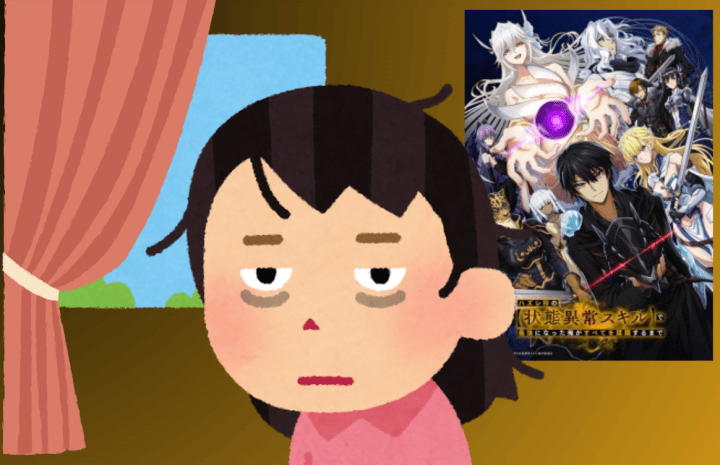
MATURE CONTENT WARNING: This post contains content that we at The Anime View do not think is suitable for everyone. The work being reviewed is Failure Frame: I Became the Strongest and Annihilated Everything with Low-Level Spells. Possible triggers or subjects could include physical violence, sexual violence, misogyny, and the sexualization and exploitation of women and younger characters. By clicking “Keep Reading” or “Read more” you understand that you may encounter such content. Viewer/reader discretion is advised.
Read more: [Review] Failure Frame: I Became the Strongest and Annihilated Everything with Low-Level Spells: A Vile Isekai No One Should WatchBy: Peggy Sue Wood | @pswediting
Several things brought me to writing this post. The most positive was a Papa John’s commercial featuring Tom Aglio’s voice, which sounds remarkably similar to the voice and cadence he uses in this anime’s English dub. If you’ve watched even the first few episodes dubbed, I don’t think you’ll ever be able to unhear it.
While he does have some range, this anime was just not the best example of that. Anyway, that’s about as lighthearted as this post is going to get, because this series is vile.
Last month, during one of my classes’ short story unit, we were discussing Kate Chopin’s The Story of an Hour, particularly its relationship to the troubling depiction of women in late nineteenth-century literature as being weak enough to die from things as wild as cold hands and soft pillows. When it struck me that many of my problems with this series stem from a similarly troubling, though for different reasons, portrayal of women and men. In fact, the more I thought about it, the more difficult the anime became to leave un-reviewed.
I don’t mean difficult because of its animation, pacing, or even the usual questionable writing one might expect from a mediocre isekai. Because, personally, I enjoy a trashy isekai. I’ve probably, this year alone, consumed something like 200 Chinese shorts dramas that follow the same poorly done plot over and over, which I’m perfectly happy to indulge in 200 more times before the year ends. Questionable world-building, ridiculous power fantasies, overpowered protagonists, and the occasional narrative dumpster fire are all perfectly delectable trash for me and that’s because it is entertaining for me to watch something that doesn’t take itself too seriously just as much as it is to watch a series that has put in some real, distinguishable effort. However, liking or disliking this series isn’t a matter of having trashy taste. This is just vile and I must recommend against watching it.
When calling it difficult, I mean the way it depicts sexual violence, misogyny, and the casual objectification of women is hard to watch without feeling a little sick. Almost every male character who isn’t the protagonist seems to be either an outright rapist or a potential rapist simply waiting for an opportunity, including others from his class that transmigrate to the new world with him. The disturbing part is how frequently this comes up and how casually the series seems to treat it.
Women are repeatedly placed in situations where sexual violence is an obvious threat, yet their reactions often feel strangely disconnected from the danger the narrative itself establishes. I mean, they may adopt a fighting stance when confronted, but there is remarkably little sense of the fear or vigilance one might reasonably expect from someone living in a world where men are so openly predatory beyond direct confrontations in the series. Women continue to move through their surroundings with an apparent normality that feels completely at odds with the behavior of the men around them. This isn’t limited to adult women, either. The series seems perfectly comfortable extending this atmosphere of sexual objectification to girls and younger characters.
One could argue that the rape culture in this world is so painfully normalized, that the women don’t act in the way one would expect. However, I would disagree with that interpretation. Instead, the women in this series seem to be caught by surprise each time they’re in a position to be potentially assaulted. It’s a bizarre disconnect. If the world is genuinely this dangerous for women, why doesn’t that danger meaningfully shape how they live, interact, or understand their surroundings? The characters and their behavior feel strangely detached from the environment the story has supposedly created. There is no convincing sense of how such a pervasive threat would shape a society, its relationships, or even its everyday routines. The result is less an intentional examination of a brutal world and more a succession of disturbing scenarios that the narrative seems content to move past.
Episode 8 offered perhaps the only woman I’ve seen in a relatively authoritative position: an innkeeper, as far as I could tell. Unfortunately, she is hardly a breath of fresh air. She’s cruel and one of the very few women in the series who isn’t simply the target of some degrading remark. Instead, she becomes an instigator of the same horrors, threatening to sell other women, even and particularly worse a child, into what can only be understood as sexual exploitation and abuse. So, even the rare instances of female authority (this woman and the goddess in the series) are presented through another variation of cruelty.
What frustrates me most is that this material could have served a meaningful purpose in the story, which I even hate writing or stating as a claim. In a world in which women face pervasive sexual violence, this could be an important part of the setting’s social structure. It could inform the protagonist’s characterization, expose the brutality of the society, or provide a genuinely disturbing contrast between his morality and that of the people around him in the ways other isekai have done before. However, to do this, the female characters would need to present a reasonable change in behavior that matches what this kind of world and ethics would do to that half of the population because the present depiction is not it.
I had much the same reaction watching this as I did during Episode 6 of The World’s Finest Assassin Gets Reincarnated in Another World as an Aristocrat. I kept thinking about the children in that episode and the extent of the trauma they would have endured having been kidnapped, sent to an orphanage, and subjected to years of physical and sexual abuse. I couldn’t stop wondering how these children, in The World’s Finest Assassin Gets Reincarnated in Another World as an Aristocrat, were expected to recover from that kind of sustained violence in the relatively short amount of time the series allowed to be featured “happy” in another episode not too far off time-wise from then. Frankly, I’m not sure my own psyche has recovered from watching it either.
That’s the problem with these sorts of narratives. Depicting horrific things isn’t inherently bad storytelling. Fiction can, and often should, confront uncomfortable subjects. However, there is a difference between depicting violence as part of a thoughtfully constructed world and using it as a recurring narrative device without giving its consequences any meaningful consideration. In this show, the creator(s) present these predatory moments with seriousness, making it seem like the characters might really be in danger only for the moment to quick wrap itself up and each female character to act as if they were never once before confronted with the grim potential of sexual assault before.
It’s not played for laughs, but it’s not given any real weight either, which is what frustrates me while watching. By depicting these rather gruesome almost assaults in such a away, it becomes clear that the creators of this particular series couldn’t give the women the respect they deserve as victims. They don’t consider how these experiences can cause pain, exhaustion, and–through such exposure–a normalization with unique ways to cope.
Consider our real-world as an example. In the US, according to the Centers for Disease Control and Prevention and data from the National Sexual Violence Resource Center, approximately 1 in 5 women in the United States (roughly 20%) experience completed or attempted rape in their lifetime. Of that number, 1 in 3 women often have this experience for the first time between ages 11 and 17. That’s way, for example, many women practice keeping keys between their fingers while walking, or own pepper spray, or leave in groups whenever going somewhere at night, or don’t want to give out their numbers to strangers, or avoid being alone with men before they know them better–the list can go on for miles. Of course, of everyone experiences an assault. As statistics show, 4 out of 5 escape such experiences, but 20% of a population is still a lot of people and with that comes a culture normalized to the idea of, for example, women’s self defense classes.
In this series, we don’t see how this kind of behavior creates a different culture. We see normal women being surprised that every man they meet is a potential rapist… every time it happens… which is just about every episode.
So, yeah. My recommendation is: Do not watch.
As an additional note regarding context of this series: after watching the first few epsiodes, I went looking through the reviews on MyAnimeList, I noticed quite a few comments about the animation and other technical shortcomings, but surprisingly little to no discussion of the content that I found most concerning. To be fair, some reviewers do mention it, but it wasn’t among the top ten (or even fifteen) reviews at the time of writing. Had I known this was part of the content, I probably wouldn’t have watched it. I found several points of this series to be materially distressing, even more so after reflecting on the reviews surrounding this post that rarely mention this or brush it off as being typical of an isekai.
I think that’s worth talking about too but that’s a post for another time.
Developmental edits by: Krow Smith | @coffeewithkrow
Discover more from The Anime View
Subscribe to get the latest posts sent to your email.
